
Farmland was in demand in 2010 thanks to rising commodity prices and low interest rates. Investors had stiff competition from farmers whose good crop yields gave them plenty of cash to spend. Overall, 2010 land markets were flat statewide.
Jul 15, 2011
Level Land: Texas Rural Land Markets 2010
Flat as a pancake. That pretty much sums up 2010 land markets. Large transactions were rare, and cropland was in demand.
Texas land markets were nearly flat statewide in 2010. The size-adjusted price per acre inched up 1 percent to $2,098 from $2,074 per acre in 2009 (see table). Data suggests an overall firming of prices in a relatively slow land market.

The real or inflation-adjusted price of $389 per acre in 1966 dollars stayed below 2008’s record $424 and marked only a $1 rise in real prices over 2009 (Figure 1). Nominal prices reflect actual prices paid while real prices represent those nominal prices adjusted for inflation.

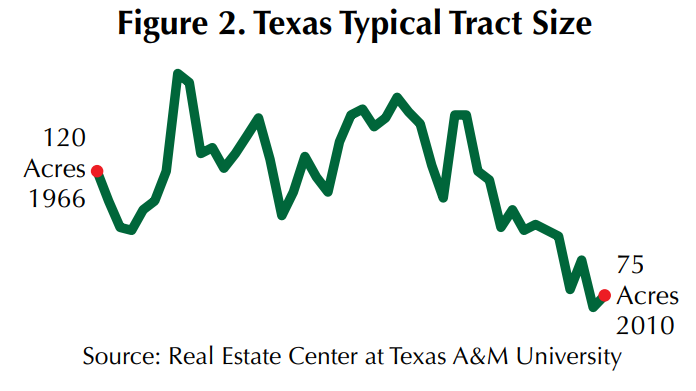
The 2010 market was focused on the smaller end of the tract size range. Median tract size expanded to 75 acres from 74 acres in 2009 but remained well below the 100-acre levels seen in recent years (Figure 2). This trend shows the numbers of large properties in the market are continuing to drop. Brokers in the field report pricing impasses between potential buyers and large tract sellers in 2010. Large property transactions remain rare in most markets.

At 4,747 sales, 2010 market volume surpassed the 2009 total of 4,321 by 10 percent (Figure 3). Much of that increase came in the fourth quarter. The 2009–10 market volumes roughly approached sales volumes posted in the 1996–2001 era. However, the Hill Country–West area through San Antonio and Fredericksburg led the trend, posting increases ranging from 27 to 55 percent above 2009 levels. Volume varied in other areas, rising in some regions while dropping in others. The modest increase suggests that the pronounced falloff in activity that began in 2007 may have stabilized in 2010.
Rising commodity prices and fears of inflation sparked continued interest in cropland. Fourth quarter 2010 saw an increase in prices and volume after third quarter declines. However, at the local level, price trends varied widely. Sales volumes continued to be weak by recent standards, but began to approach 1990–2000 volumes.
Appraisers and brokers report that potential buyers continued to make low offers, assuming prices will eventually drop. Buyers still resisted paying current prices, but some, weary of delaying purchases, completed their transactions.
If there is no further external shock to the economy, markets may escape the wrenching declines posted during the 1986–1992 downturn. Back then, an abundance of leverage made markets vulnerable to the economic downturn. When buyers could no longer make debt service payments, they tried to sell to settle their debt. Many defaulted and watched helplessly as lenders foreclosed. Land flooded the market. Prices plunged.
Current markets could face a similar fa te if current owners depended on borrowing to finance acquisitions. If markets escape further erosion, it will be in part thanks to the prevalence of all-cash purchases from 2001 to 2007, which undoubtedly softened the blow of economic turmoil.
Cropland investors are looking for land to purchase. They are in competition with farmers, flush with profits from burgeoning commodity prices and good crop yields. The result: strong demand is facing restricted supply as current owners opt to keep their land.
Despite the threat of production shortfalls caused by drought, cropland prospects appear to be positive in the near term. Soaring commodity prices, record low interest rates, a weakened dollar, production shortfalls, and expanding use of food crops to manufacture biofuels have combined to create a frenzied rush to buy farmland.
However, growing numbers of observers fear that cropland prices have become overheated. They believe a reversal of one or more of the supporting factors is highly likely. Those changes could incite a precipitous decline in cropland prices when they occur.
Because of the cessation of development in urban areas, transitional tracts near urban areas still face slack demand over the coming year.
Dr. Gilliland ([email protected]) is a research economist and Gunadekar, Sriram and Gross are research assistants with the Real Estate Center at Texas A&M University.
Did you like this Article?

You might also like

Land Markets
8 minute read
Jun 26 2024
Credit Availability’s Effect on Texas Rural Land Markets
Texas’ varied landscapes support diverse land uses, creating competition among potential buyers. Specifically, in growing metropolitan areas like Dallas-Fort Worth or Houston developers seeking land for urban expansion (housing, commercial, industrial) compete with buyers who have agricultural interests (farming, ranching).


Land Markets
18 minute read
Sep 07 2023
Texas Small Rural Land
Since 1966, the Texas Real Estate Research Center has collected a large sample of rural land sales data from across Texas. The reported transactions include a mixture of land uses including but not limited to farming, ranching, wildlife management, recreation, and mineral extraction.


