
Bay City Rolling: Corpus Christi Thrives on Change
Corpus Christi is growing and changing with plentiful activity in the educational, tourism, retail, industrial and residential sectors.

Where in Texas does a public university sit on an island adorned with palm trees? Where in the Lone Star State does a 28-story Class-A office tower overlook sailboats in a bay? Where are large stretches of oceanfront beach property still available for development? The answer is Corpus Christi.
Not many people, even Texans, are aware of the renaissance taking place in Nueces and San Patricio Counties. Along this stretch of the Coastal Bend, positive changes are creating opportunity for real estate investment and development.
Tourism, Convention Activity Full Speed Ahead
Corpus Christi convention activity is focused in the area at the north end of Shoreline Boulevard near the Harbor Bridge. The anchor, the AmericanBank convention center, is currently going through a complete renovation and expansion that will double its size.
Scheduled for completion in fall 2004, the center will have a 2,526-seat auditorium, a sports arena seating 10,500 and meeting and exhibition space all under one roof. The sports arena will be home to a professional minor league hockey team and Texas A&M–Corpus Christi basketball. Both large Omni Hotels nearby offer spectacular views of the bay.
The city has made strong efforts to boost tourist attractions to further enhance convention business. In 1990, the Texas State Aquarium opened on the north side of the harbor entrance. Dolphin Bay, the newest exhibit, offers visitors an opportunity to get face-to-fin with dolphins and other species native to the Gulf of Mexico.
The aircraft carrier U.S.S. Lexington was moored in the bay in 1992. Visitors can tour the carrier, see the aircraft and discover the history of the ship known as the Blue Ghost.
In summer 2004, ground was cleared near the convention center for Whataburger Field, a $25 million baseball stadium. The field will be home to the Corpus Christi Hooks, the AA farm team of the Houston Astros. Land is being prepared for retail development and a hotel site near the new stadium.
Island University Growing
Texas A&M University–Corpus Christi continues to expand. A $40 million performing arts center is under construction. The facility’s signature feature will be a glass wall offering a panoramic view of Corpus Christi Bay. Another project, the $60 million Harte Research Institute for Gulf of Mexico Studies, will bring researchers and research dollars to the city.
Fall 2003 enrollment grew to 7,860 students, up from 7,200 students the previous year. This enrollment growth has created additional demand for housing and retail services in the university area. Many apartment complexes are located along Ennis Joslin Road to serve students and nearby military bases.
As enrollment continues to expand in the coming years, more apartments and retail should develop in this area. Currently, there is almost no retail serving the immediate area of the island campus.
Reopened Channel Promises Development
Across the bay on Padre Island, which starts at Corpus Christi and runs 150 miles south to Mexico, is one of the region’s most important public projects. The $30 million Packery Channel project is a partnership between the City of Corpus Christi and the Corps of Engineers that will result in the reopening of a long closed channel between Corpus Christi Bay and the Gulf of Mexico. In addition to providing Gulf access for boaters, the project will open up 400 waterfront acres for development. When the channel is completed, Corpus Christi boaters will no longer have to make the lengthy trip to Port Aransas to get into the Gulf.
The City of Corpus Christi has annexed most of the beaches on Mustang Island, resulting in daily sand cleaning, new amenity investment and more public safety officers. This will benefit visitors and residents of Mustang Island alike and should help the city attract more tourism dollars.



Trade Corridor Will Harbor New Industry
Corpus Christi entered the arena of global trade in 1519 when Spanish adventurer Alonso Alvarez de Pineda sailed into the bay and claimed the area for the king. More recently, the Port of Corpus Christi opened in 1926 and has become a vital artery in the flow of world trade.
Crude oil from the Middle East and Venezuela arrives daily to supply local refiners with the feedstock to produce gasoline and chemicals that are the backbone of American industry. Military equipment of all types makes its way from Fort Hood to Iraq through the port.
Recent developments show how the port stays on the front edge of the shipping industry. Ground has been broken on a $55 million project to develop the Joe Fulton International Trade Corridor, which will add 11 miles of roadway and six miles of rail that will greatly enhance accessibility on the north side of the ship channel. The roadway is expected to be completed in 2008. The project also will open 1,100 acres and four miles of frontage on the ship channel for industrial development.
In addition, several companies are likely to build liquefied natural gas (LNG) processing facilities at the port. When the cryogenically frozen natural gas arrives, it will be warmed until it returns to a gaseous state and then transported by pipeline to buyers. The byproduct of this process is an enormous quantity of “cool.” Other industries, such as the frozen food processing industry, are likely to locate near these facilities to take advantage of this resource.
Plans for the port include development of the 1,100-acre La Quinta Container Terminal on the north shore of Corpus Christi Bay near Ingleside. This would open the area to receive containers of manufactured goods and produce from other countries.
Residential Building Frenzy
Residential housing construction has exploded in three distinct areas of Corpus Christi. Many vacation and permanent resident homes are being built on Padre Island for those who enjoy water access and the beach. A wide array of housing is available in south Corpus Christi in the Staples Avenue at Oso Creek area near Kings Crossing Country Club. The third growth area is in the northwest near Calallen.
The number of building permits for single-family homes in Corpus Christi increased 76 percent from 1999 to 2003, from 942 to 1,659. The building frenzy continues in 2004, with single-family permits for the first five months up 27 percent from the same period in 2003.
Home sales volume in the Corpus Christi market has set a new record every year since 1998. Sales in 2003 totaled 4,198, up 32 percent from 1998. The pace has quickened in 2004 with sales in the first five months running 16 percent higher than the same period a year ago. The median price in May was up 13 percent from a year earlier, but at $116,800 is still affordable.
Apartment construction has been modest in recent years, with only 764 units built since 2000. Occupancy rates have remained at high levels, with Apartment MarketData Services reporting an overall occupancy rate of 95.4 percent in May 2004. An 82-unit waterfront apartment community on Padre Island was completed in 2004, with two-bedroom units renting for $1,000 per month.
Retail Follows Housing’s Wake
Like housing, the retail sector is experiencing unprecedented growth. The city’s primary retail corridor is centered along South Padre Island Drive. Many large national retailers have recently announced or completed stores in this area, including Bed, Bath & Beyond, Conn’s, Best Buy, Marshall’s, Ross Dress for Less and Starbucks. Projects currently under construction include a Lowe’s Home Improvement Center and an adjacent 30,000 square feet of retail space.
Rapid housing construction in south Corpus Christi is spawning retail development. Saratoga Boulevard, which serves as the south side’s primary north-south arterial route, is becoming the location of choice for many retailers. Expansion is currently centered on the Staples Street–Saratoga Boulevard intersection.
In fourth quarter 2003, developers completed an 85,000- square-foot Kohl’s department store and started an additional 50,000 square feet of in-line retail space at the northeast corner of the adjacent intersection. Preleasing activity includes tenants such as Petco, Keva Juice and Quizno’s Subs.
In addition to this development, a 45,000-square-foot retail center is under construction approximately one mile to the north. The project will be named Regal Plaza and is being marketed as a high-end center. Annual quoted rents in the project are $12 to $20 net of common area maintenance, which is estimated at $3.60.
Offices on the Waterfront
The Corpus Christi office market has experienced a moderate increase in leasing activity. Expansions in the legal and finance, insurance and real estate industries drove absorption activity during 2003, as overall net absorption was more than 60,000 square feet.
As a result, the market’s overall vacancy decreased to 14.1 percent compared with more than 15 percent at the end of 2002. Over the same 12-month period, marketwide lease rates increased approximately 2 percent. However, the increase was more attributable to a rise in expenses than a significant increase in demand, as insurance costs have escalated over the past year.
No speculative office construction has occurred since the mid-1980s. The local tenant base consists primarily of 5,000- to 10,000-square-foot users. Large users (over 50,000 square feet) are scarce.
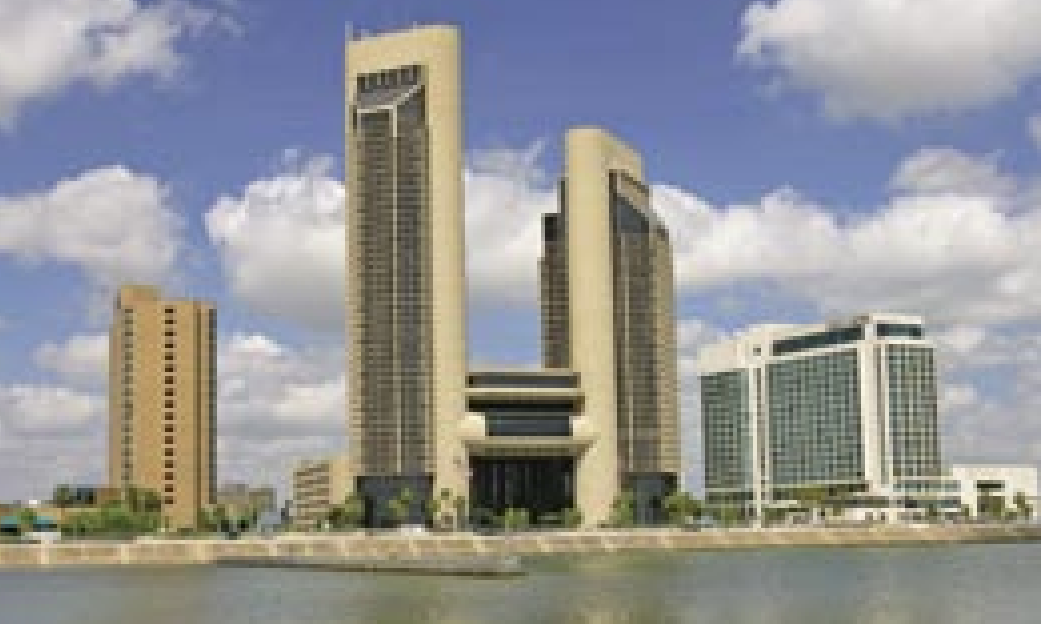
Significant space is available in the two Class-A buildings in the central business district, One Shoreline Plaza and the Frost Bank Plaza, with waterfront space available for $8 per square foot triple-net. Rental concessions are abundant, with landlords reportedly considering an expenses-only lease for tenants who will build out their own space at $20 per square foot. Clearly, this market creates a tremendous opportunity for Texas businesses to enjoy waterfront views at an economical price.
What’s on Horizon?
The winds of change are blowing through this tropical cove on the Coastal Bend. Interesting real estate investment and development questions abound.
What kind of retailers will locate near the new baseball stadium? Will the expansion of the convention center create demand for another hotel nearby? What kind of industrial development will take place on the north side of the ship channel in the wake of road and rail improvements?
How long will it be before a major resort developer reshapes the sandy beaches of Padre Island? What kind of housing and retail amenities will boaters need when the Packery Channel opens access to “blue water”? How many more apartments, condos and townhomes will be needed to house students at the university in years to come? Where will restaurants, bars, coffee shops and bookstores locate to serve the growing student population?
Stay tuned for the answers.
Dr. Dotzour ([email protected]) is chief economist with the Real Estate Center at Texas A&M University and Adame ([email protected]) is vice president of Adame Realty Advisors Inc.
You might also like


Corpus Christi Industrial Development
Five years ago, forward-thinking Corpus Christi leaders set out to attract global industries that use natural gas and natural gas liquids as raw materials. Today, over $28 billion in new projects are under construction or in final permitting.


