
Victoria’s No Secret: Multiple Economic Engines Drive Market
A review of real estate markets in the Victoria Metropolitan Statistical Area.

Victoria is the second oldest incorporated city in Texas. Originally known as Cypress Grove, Victoria was given as a land grant in 1824 to Don Martin de Leon by the Mexican government which detailed a town to be built on the bank of the Guadalupe River. It was named Victoria after the patron saint of Mexico. Now, Victoria is the largest city (population more than 61,000) in the “Golden Crescent” region. It serves as the health, education, government and retail service center for a five-county market area with a population of 182,000.
Several economic engines drive the local economy, including the petrochemical industry, regional health care, oil and gas exploration, retail trade and agriculture. Economic growth has been driven in the 1990s by an influx of plastics manufacturers, industrial chemical plants and new oil and gas exploration. The area’s economic rebound started in 1988, sustained by recovering markets for petroleum products and large petrochemical plant and port expansions in Victoria and the nearby Port Lavaca and Point Comfort areas.
A $1.3 billion expansion of the Formosa Plastics facility in Point Comfort was completed in 1994. This increased the area’s petrochemical processing capacity to more than five million tons per year. A $42 million port expansion and renovation project was completed in 1994 to accommodate Formosa’s new capacity. Because Formosa uses only 15 percent of the new capacity, port officials plan to attract other petrochemical plants to the area.
Enhancing future economic growth prospects, Victoria residents approved a bond issue for a $35 million project to broaden and deepen the Victoria Barge Canal. Scheduled for completion in 2000, the canal connects Victoria to the Gulf Intracoastal Waterway and the deep-water port of Port Lavaca-Point Comfort.
BP Chemical is constructing a $40 million expansion project on a 40-acre Port LavacaPoint Comfort site. Also planned is a 25- mile pipeline linking the port with BP’s Green Lake plant. There, ammonia is processed into acrylonitrile, which is used to produce acrylic fiber and plastic items like carpet backing, blankets and clothing as well as housings for telephones and computers. The Green Lake plant is the world’s largest producer of acrylonitrile.
In addition to the waterway connections, roadway improvements are being made that will significantly enhance the city’s economic future. As part of the North American Free Trade Agreement Interstate plan, the new I69 will pass through Houston, Victoria and Corpus Christi, on the way to the international border in Brownsville. Improving Highway 59 from Victoria to Laredo also is under consideration. In addition, substantial improvements to Highway 87 will make the shipment of goods in and out of the area even easier.
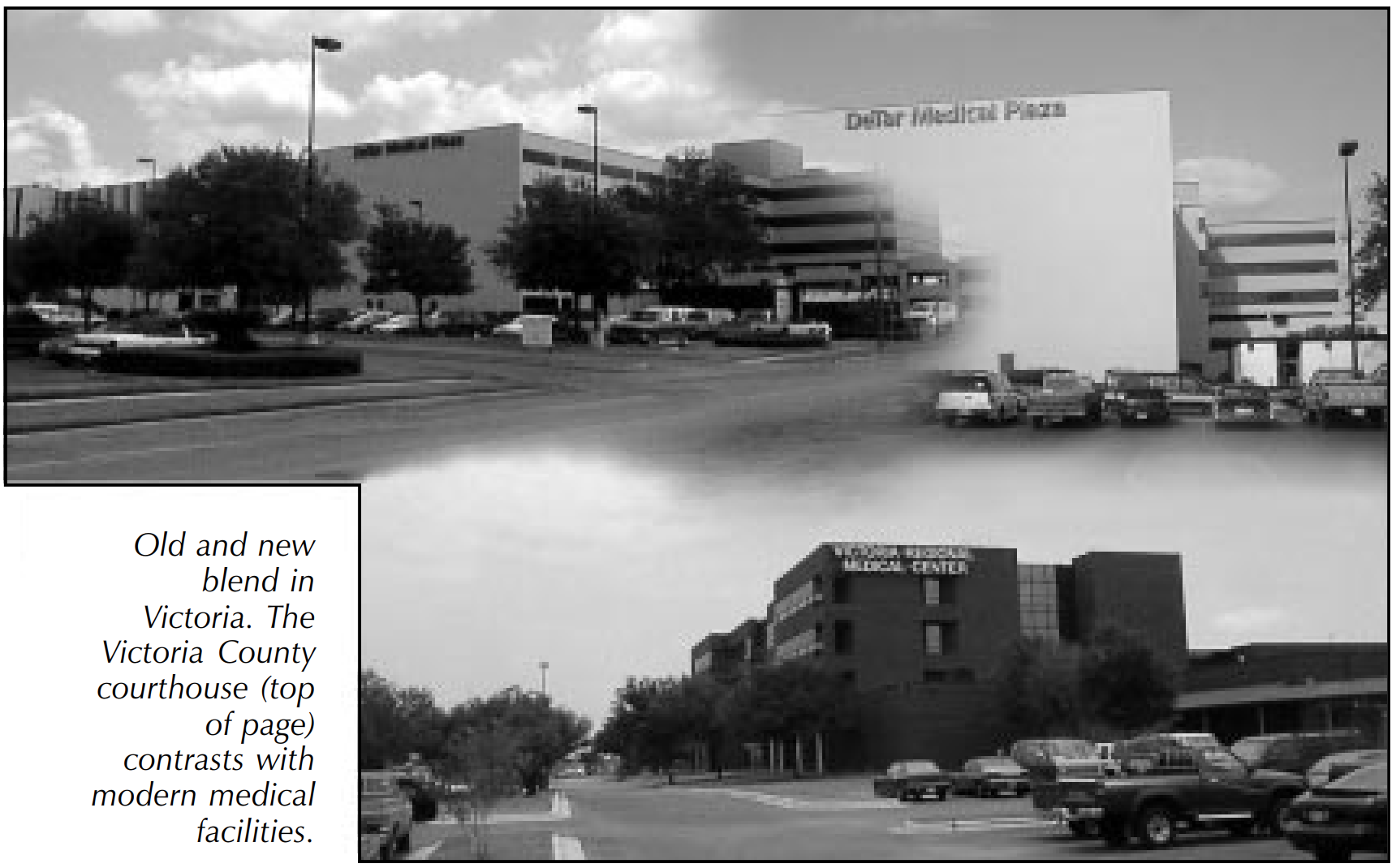
Local planners estimate that the Victoria County population will grow by about 1,000 each year for the next 10 years. Municipal authorities report that water and wastewater facilities are available to meet future growth projections. The primary source of water comes from wells in the Gulf Coast Aquifer. Victoria plans to create a new water source by building a plant that will treat surface water from the nearby Guadalupe River and gravel pits (recently donated) in the southwest area of the city.
The apartment market has become active in the past year. One new upperscale complex with 160 units was recently completed in the northwest part of town. Another 160-unit apartment project is under construction currently, and a third project is planned. Occupancy rates are approximately 95 percent and two-bedroom apartments rent for an average of 55-60 cents per square foot.
Much of the retail trade in Victoria is located along Navarro Avenue (Highway 77), with the highest concentration located in the northern part of town at the intersection with Loop 463. Most new retail development has occurred in this area. Recent additions include big box retailers and restaurants. Retail rental rates range from $10 to $12 per square foot for class A retail space outside the mall.
The office market is located largely in the downtown square area and along Navarro Avenue. Class A rental rates range from $14-15 per square foot, and class B offices rent for $11-12 per square foot.
Home sales volume has been increasing steadily for the past three years, with 681 homes sold in 1997. The market has continued at a brisk pace in 1998. The median sales price reported by the MLS in May, 1998 was $72,700.
Much of Victoria’s residential growth has occurred in the northeast quadrant. Another upper-end development is in the northwest area near the growing medical complex. In addition, the western quadrant of Loop 463 is expected to be completed by the end of 1998, opening up this area of the city to future development. This section of town is currently undeveloped and consists of beautiful rolling topography. The highest level of future growth in the community is expected to be in this area.
For additional information about home sales, see the Center’s Web site at trerc.tamu.edu. The Web site contains more than 11,500 pages of information that is useful to real estate professionals
Dr. Dotzour is chief economist for the Real Estate Center at Texas A&M University


