Laredo’s industrial market weathered the recession and is ready for the future. Freight is flowing efficiently across five bridges. New “weigh in motion” technology records truck weights as they drive over a sensor, and huge increases in the value of automotive and cell phone equipment shipped has positioned the city to better compete with Asian markets.
Jan 24, 2011
Bridges to Everywhere
Stiff competition with China spurred Laredo’s industrial market to get itself in fighting form. Now, thanks to improvements in infrastructure and technology, the border city is poised to win back business.

IF FREIGHT TRANSPORTATION CORRIDORS were fiber optic cables, Laredo would be the “phat pipe” of border trade flows. The city has earned a reputation for high-speed, high-volume transfer of goods between Texas and Mexico, becoming a dominant force in U.S. cross-border commerce.
Like other areas heavily dependent on strong international commerce, Laredo has felt the pinch of the latest global economic downturn. A temporary shutdown of trade flows caused by Hurricane Alex and ongoing Mexican drug violence have also fed perceptions that other regions may offer a more favorable business environment.
A closer look at recent figures and emerging trends paints a different picture. Although the stumbling economy did result in a setback, Laredo is already showing signs of a turnaround. That’s good news for the future viability of Laredo’s 40 million square foot industrial real estate market.

Bridging the Border
Five bridges cross the Rio Grande in the Laredo area. The Laredo International Railway Bridge supports the largest rail freight gateway into the United States, according to the Laredo Metropolitan Planning Organization (MPO). The Gateway to the Americas International and Juarez-Lincoln International bridges are located adjacent to downtown Laredo and are primarily used for pedestrian and noncommercial vehicle traffic.
The Colombia Solidarity International Bridge handles both commercial and noncommercial traffic. The World Trade International Bridge processes commercial truck traffic exclusively and is the state’s busiest international commercial bridge according to the Laredo MPO.
The value of international goods funneling through Laredo has increased significantly according to the Texas Center for Border Economic & Enterprise Development’s publication, Border Business Indicators. The value of U.S. exports to Mexico via Laredo through mid-year 2010 increased 37.7 percent over the same period in 2009. Dollar value increased from $20.1 billion to $27.7 billion.
The value of imports headed north through Laredo registered a 40.7 percent increase, moving up from $22.3 billion to $31.5 billion when benchmarking the same six-month intervals. The total dollar value of goods being transported north and south through Laredo represents 40 percent of all trade crossing the U.S.-Mexico border via inland ports.
The forecast for future freight flows through Laredo is strong. The Federal Highway Administration stated that the value of freight passing through the port of Laredo using all modes of commercial transportation will increase 29 percent by 2015.
New Technology Speeds Transportation
The City of Laredo has invested $9 million in an automatic vehicle identification (AVI) system used on southbound traffic. AVI is in use at the Juarez-Lincoln, Columbia and World Trade bridges, drawing toll charges out of customer accounts electronically. In this way, no money changes hands at the bridge. The AVI system uses an electronic “Laredo Trade Tag” to trigger the toll payment.
A “weigh in motion” system has also been installed at the Juarez-Lincoln and World Trade bridges, dramatically improving freight flow at those crossings. The World Trade Bridge is the only U.S. bridge implementing both the AVI and Weigh in Motion systems to clear heavy commercial trucks. On average, a truck can be weighed and charged electronically in about 15 seconds. Laredo’s toll revenue for 2010 is estimated at about $42 million, with 55 percent of that revenue generated by commercial traffic.
The city completed a $5 million lane expansion at the World Trade Bridge in December 2010. The expansion added seven primary inspection lanes, making a total of 15. The city has announced it will construct refrigerated inspection facilities for perishable goods at the World Trade and Colombia bridges at a projected cost of $1.3 million.
Automobile, Electronic Components Dominate
The number one export and import passing through Laredo is motor vehicle parts, according to WorldCity’s president, Ken Roberts. WorldCity is a Coral Gables, Fla., media company that identifies trade trends by analyzing U.S. census data.
“The value of motor vehicle parts shipped through Laredo in July 2010, the latest data available, was about $10 billion,” says Roberts. “This represents an 87 percent increase over July 2009.”
Roberts also reports that the value of Laredo’s number two export, cell phone equipment, was $1.8 billion in July 2010.
“We calculated that, since 2002, the value of cell phone components being exported through Laredo has increased more than 2,000 percent,” Roberts said at Laredo’s 17th Annual Logistics and Manufacturing Symposium.
Rail Activity Continues Climbing
Based on value, about 80 percent of freight passing through Laredo is transported by truck. However, rail activity through the region continues to develop. Laredo is one of seven rail ports of entry along the U.S. Mexico border.
Two Class 1 railroads, Kansas City Southern (KCS) and Union Pacific (UP), service Laredo. KCS owns the International Railway Bridge, but UP has an agreement with KCS to use the bridge. Both railroads maintain switching facilities in the Laredo area.
UP maintains an intermodal facility, known as Port Laredo, on the American side about ten miles north of downtown. Facility officials report that intermodal activity in the yard has recently exceeded prerecession levels. About 70 percent of the yard’s activity is related to motor vehicles.
On the Mexican side, Kansas City Southern de Mexico (KCSM), a subsidiary of KCS, operates the Sanchez intermodal terminal 11 miles southwest of Nuevo Laredo. KCSM offers a direct rail link from the International Railway Bridge to the Pacific port of Lazaro Cardenas, a distance of 953 miles.
Container traffic from Lazaro Cardenas to Laredo now offers shippers an alternative to U.S. West Coast ports. Michael W. Upchurch, chief financial officer and executive vice president of KCS, reported that KCSM transported 700 containers from Lazaro Cardenas to the United States during August 2010 and expects that volume to continue to grow.
According to Upchurch, lower labor costs and the absence of environmental fees at Lazaro Cardenas can save importers 15 to 20 percent compared with shipments using West Coast ports.
The Laredo MPO forecasts that the International Railway Bridge will exceed its capacity of 40 trains per day by or before 2020. As a result, the Webb County Rural Rail District, KCS and UP are considering an additional rail bridge in their long-range planning.
Novel Idea for Airport
The Laredo International Airport’s master plan projects that between 2010 and 2025, air freight will grow 7 to 11 percent annually. “Attaining the higher end of the range will depend on whether Laredo’s air cargo business can diversify beyond the auto industry,” says Airport Manager Jose Flores.
U.S. Rep. Henry Cuellar is working with the City of Laredo and the airport to obtain approval for establishing Mexican customs, immigration and agriculture facilities to pre-clear cargo bound for Mexico at the Laredo airport.
“We are trying to be the first airport in the country to have Mexican Customs pre-clear goods bound for Mexico here in the United States,” says Cuellar. Companies involved in air freight with facilities at the Laredo airport include UPS, FedEx, DHL, BAX Global and Swiss Port Air Cargo.
State of Industrial Market
Like much of the country, Laredo industrial rental rates have taken a hit.
“Warehouse rents have dropped from about 35 to 40 cents per square foot, triple-net, at their peak in mid-2008 to around 25 to 30 cents today, depending on the age of the property,” says Eduard Villareal, senior associate at Best/White Real Estate Brokerage in Laredo (see table).
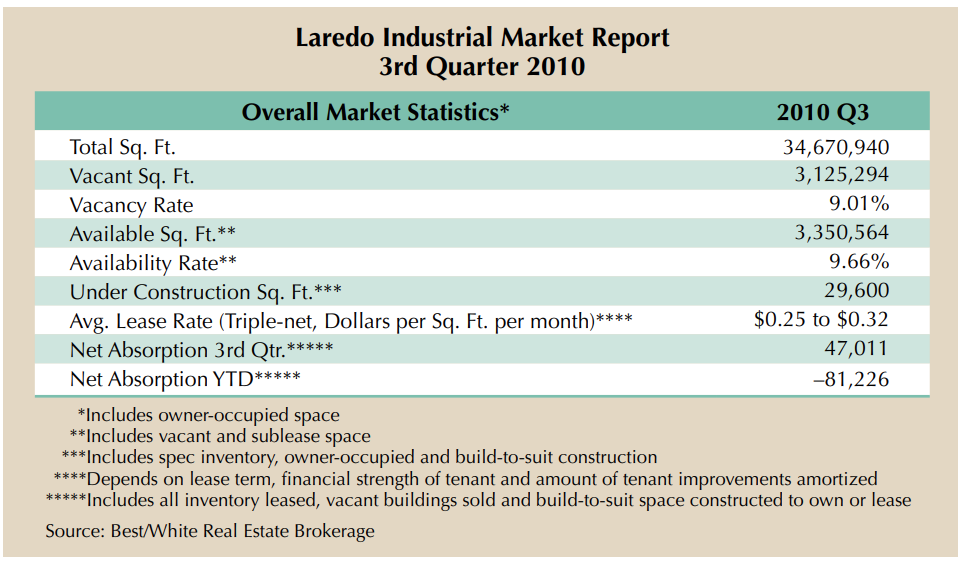
The average length of new leases being written is about two years. Although this may seem fairly short, Villareal says that shorter leases have always been typical in Laredo.
Cristy Swisher, broker-owner at Swisher & Martin Realty, agrees. “Tenants have not been asking for any shorter leases than they have in the past. Leasing has started to pick up a bit, and I am starting to see some positive absorption again.”
Swisher is noticing more warehouse space for sale than before. “Unfortunately, there are not many lookers. It may be due to the lack of available financing. It still feels like there is a lot of uncertainty for businesses out there.”
“We still have a large contingency of unoccupied space in our market,” notes Villareal. “But we have seen a few owner occupied sales. There are also very few foreclosures taking place in our market.
Steven Wright, broker-owner at Wright Realty, adds, “Everybody looking to buy wants a discount. More people seem to be interested in leasing rather than purchasing warehouse space. I do believe that 2010 has been a better year than 2009 overall. We’re slowly improving.”
“One trend I have seen is consolidation of firms,” says Swisher. “Earlier in 2010, we saw a number of smaller import-export firms and trucking companies disappear. Many may have lost their one client and had to close as a result. The bigger companies are capturing more clients.”
The consolidation of firms has been a factor in the industrial sector’s slow turnaround. “We’ve felt the downsizing of warehouse space in Laredo,” says Daniel Zuniga, broker with Killam Development Ltd. “Now we’re waiting for the expansion to return.”
Both Swisher and Villareal agree that the flooding caused by Hurricane Alex had no long-term effect on Laredo’s industrial market. “Some shippers may have briefly considered relocating to other inland ports,” says Villareal. “But alternate locations just don’t have the capacity Laredo has in infrastructure and warehouse space.”
Emerging Industrial Sector Trends
“Product life cycles are becoming shorter and manufacturing facilities are becoming more mobile,” says Dr. Barry Lawrence, director of the Supply Chain Systems Laboratory at Texas A&M University.
“We may begin to see more manufacturing come to the Texas side of the border. Multinational firms are becoming an outdated model. Business requires the agility to make decisions with local knowledge to meet local needs.”
Lawrence believes that manufacturing centers closer to the customer offer a number of advantages, including lower transportation and logistics costs, shorter inventory lead times and possibly less foreign currency risk.
“The focus for manufacturers has been on low-cost production,” he says. “It should instead be on optimizing throughput and improving a region’s competitive advantage.” Throughput is the speed and volume of products moving through the manufacturing and transportation process.
“Both sides of the border need to examine automation and other procedures as a way to increase efficiency and become more competitive with Asia,” Lawrence asserts. Higher supply chain efficiency is what will attract more firms, providing the financial justification for government entities to invest in more and better infrastructure in that region.
Drug Violence’s Effect on Commerce
There is no doubt that violence along the Mexican side of the border has become a problem. However, its effect on the mindset of businesses operating in Mexico is not as great as one would expect based on news coverage.
In a recent report by the Wharton School of Business, Wharton Marketing Professor David Reibstein argues that violence of the sort seen in Mexico is only one of the many risks corporations may face. Other risks such as political unrest or economic policy changes can be a problem as well.
In the same report, Rafael Amiel, director for Latin America at HIS Global Insight, states that there are no signs of a major exodus of foreign dollars from Mexico at this time. “We don’t see firms moving out of Mexico due to the violence,” he says.
Laredo unquestionably faces challenges. But a city with a younger than average population growing at almost three times the national average has great potential as well.
Dr. Hunt ([email protected]) is a research economist with the Real Estate Center at Texas A&M University
Did you like this Article?