
Aging baby boomers and Gen-Xers continue to dominate most housing markets, but Generation Y will drive future housing activity. Over the next two decades, more than four million Gen-Yers per year will turn 25. As this generation creates new households, construction will return to pre-boom norms.
Oct 20, 2011
Housing for the Ages
Each generation looks at homebuying and homeowning differently. Aging Baby Boomers, make way for Gen-Y.
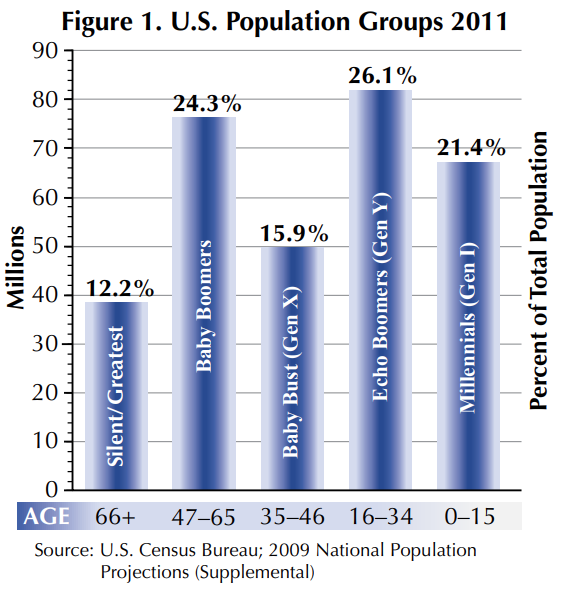
For the next few decades, U.S. and Texas housing markets must respond to demand from two primary groups: aging Baby Boomers and the more numerous Generation Y (Gen-Y), also known as Echo Boomers (Figure 1).
Baby Boomers entered the housing market in the 1970s, when mortgage interest rates exploded, peaking at more than 18 percent, and inflation pushed up the average price of a home from $25,000 to $65,000. Despite double-digit interest and unprecedented inflation, the homeownership rate rose from slightly less than 64 percent to more than 65.5 percent. Today, aging Boomers’ housing demands continue to heavily influence the quantity, quality and location of new housing.
Enter Gen-Y
Demographers generally mark the beginning of Gen-Y anywhere between 1976 and 1982 (for this article, Gen-Y starts in 1977). Gen-Yers outnumber Baby Boomers by six million, with significant differences in general economic and housing outlooks. This generational group will play a major and growing role in shaping the future for housing and the economy for decades.
Gen-Y totals almost 82 million and accounts for more than 26 percent of the total U.S. population. This is the largest cohort in history and perhaps the most economically challenged generation since the Great Depression.
For the U.S. and Texas, the Millennial group will soon surpass even Gen-Y. Some include Gen-Y in the Millennials, but here they are differentiated. Some demographers refer to this youngest group as Gen I, the Internet Generation.

Texas, with a much younger overall population than the nation, has an even greater share of Gen-Yers (Figure 2). Currently, less than 10 percent of the state population is 65 years or older (compared with more than 12 percent nationally) and 23 percent are 15 or younger (27 percent of Texas’ population are younger than 18). The two youngest population groups make up 51.5 percent of Texas’ total population compared with 47.5 percent of the U.S. population.
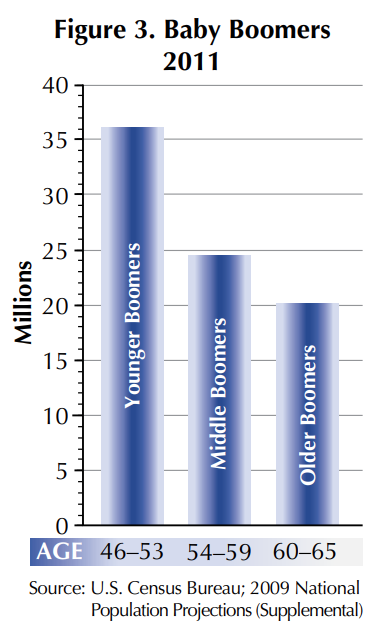
Gen-Yers are just entering their prime household formation and homebuying period. The Baby Boomers still dominate the housing market but the effects differ as the older Boomers enter their mid-60s and contemplate retirement, while the younger Boomers are still in their prime income-earning period. Overall wealth differs greatly between the early Boomers and the later Boomers (Figure 3).
Boomers, Gen-Xers Own, Gen-Y Rents
The Boomers embody the move-up, move-out and second-home markets; Gen-Xers reflect the move over and move-up housing markets; and Gen-Yers include the first-time move-in and first move-up markets. A recent FNMA National Housing Survey revealed that the Boomers and Gen-Xers are predominantly homeowners while Gen-Yers are mostly renters (Figure 4).
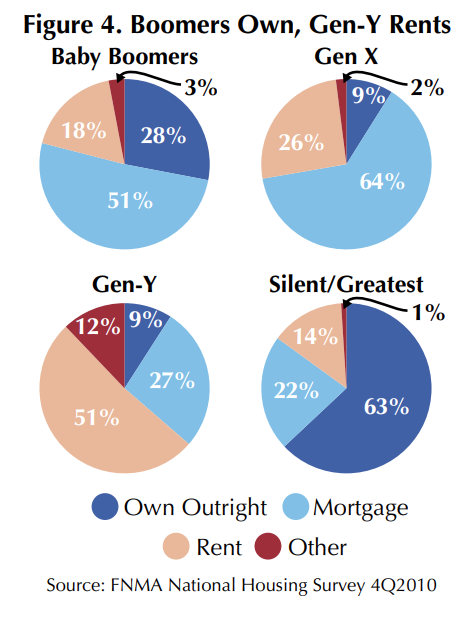
Around 79 percent of Boomers own a home either outright or with a mortgage. Roughly 73 percent of GenXers also own, although a much smaller percentage own their homes outright. More than half of Gen-Yers rent and a sizable percentage neither own nor rent but live with their parents, with roommates or in university dormitories.
Interestingly, a larger than expected proportion of Gen-Yers own a home. A sizable number of older GenYers became homeowners during the recent housing boom, when mortgages were easy to obtain, or later, taking advantage of the first-time homebuyer tax credit. More than one-third of all Gen-Yers own their homes and nearly half (an estimated 49 percent) of those not living with relatives or in dorms own their homes.
Contrary to some expectations, the Boomers, so far, have not given any indications of mass geographical relocation as they enter retirement. Their balance sheets, along with those of Gen-Xers, took the brunt of the Great Recession, with approximately half of homeowner equity in real estate lost between 2005 and 2010. Many Boomers may postpone retirement and any relocation plans out of economic necessity. Their housing demand patterns have changed dramatically, as is evidenced by the falloff in the second-home and vacation-home markets.
Gen-Yers face severe obstacles to homeownership and to their first move-up. In the current credit constrained mortgage market, first-time Gen-Y buyers are effectively precluded from buying except through FHA-insured mortgage loans. Even those with steady employment often do not have the requisite down payment. And for those who currently own their homes, selling the current house for a price sufficient to capture the necessary equity to move up is daunting. A significant proportion of negative-equity homeowners are Gen-Yers.
Recent evidence suggests that Gen-Yers remain optimistic about homeownership. Even though more than half currently rent and almost one-fourth still live with their parents, most surveys find that between 80 and 90 percent of Gen-Yers expect to own a home at some point and have a generally positive attitude toward homeownership.
A recent FNMA housing survey found that although only 61 percent of Gen-Yers versus 69 percent of the Boomers thought buying a home was a “safe investment,” 59 percent of Gen-Yers viewed homebuying as an “investment with a lot of potential” versus just 56 percent of the Boomers surveyed. All of these percentages are down from the year earlier survey as the national housing bust continues. Nevertheless, they indicate a potentially strong underlying market demand for owner-occupied homes in the future.
Housing More for Lifestyle Than Investment
A clear message from almost every survey on Gen-Y’s housing outlook indicates that this group considers housing in terms of lifestyle and social networking rather than primarily as a means of investment or wealth accumulation. They have seen home values fall, significantly in some cases, and witnessed their parents struggle with foreclosures and lost wealth.
Gen-Y’s spatial, size and design demands vary considerably from the previous two generation groups. GenYers appear to be much more interested in affordable, attractive houses in neighborhoods in proximity to jobs, services, entertainment and social interaction. Marrying later in life and having fewer children at an older age particularly alters the demand for the traditional home in the suburbs. Gen-Y is the most plugged-in, highly educated and mobile generation ever. The Internet provides the means to look anywhere in the country for jobs, things to buy, lifestyle and housing.
Gen-Y is also the most ethnically diverse generation ever, and in Texas, Hispanic Gen-Yers outnumber all other groups.
In the United States, 56 percent of Gen-Yers are Anglo, 19 percent are Hispanic, 14 percent are black and 5 percent are Asian. In Texas, however, 37 percent of Gen-Yers are Anglo, 46 percent are Hispanic, 13 percent are black, and 4 percent are other (mainly Asian).
Gen-Yers represent the future for every housing market. As with the Boomer generation, Gen-Yers separate into older and younger members. The younger members (16–24 years old) primarily live with relatives, in college dormitories or other group situations. The 25- to 34-year-old Gen-Yers exhibit strong homeownership desires.
Employment among the Gen-Yers similarly shows sharp discrepancies. While the group is generally highly educated, they are also less employed than the two preceeding generations. Many jobs simply have been taken by the Boomers and GenXers, who are now being forced to work longer than expected out of economic necessity.
The unemployment rate exceeds 17 percent for the younger Gen-Yers and approaches 10 percent for the older group compared with an unemployment rate between 7 and 7.5 percent for the Boomers and Gen Xers (Figure 5).

The emerging generation’s lifestyle choices also reflect changes in the number and composition of U.S. households, which directly affect demand for housing. Nationally, the current housing slump can be traced to the dearth of new household formations and the changing composition of households.
U.S. Households Changing
Fewer than 400,000 new households were created in the United States in 2009 and again in 2010, 70 percent fewer than the historical annual average of 1.3 million prior to 2008. Texas household formation fared better, falling by approximately 15 percent to around 106,000 new households in 2009 versus the long-term average of around 124,000 new households per year.
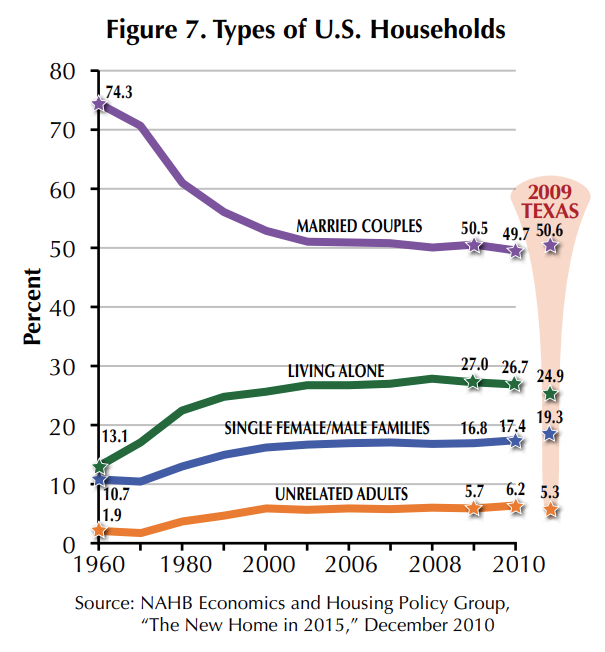
Household size and type changed dramatically in the past three decades and Texas households paralleled these trends (Figures 6 and 7).

Households shrank in size, reflecting not only the aging of America (especially the Boomers), but also the GenYers’ postponement of marriage and parenthood. The rapid growth of one- and two-person households may create a stronger demand for smaller housing units and rentals.
In Texas, households shrank but remained slightly larger than the national average because of the number of Hispanic households, which typically have more members. Even so, the pronounced increase in the number of one- and two-person households reflects the relatively young profile of the state.
Correspondingly, the proportion of three- or four-person households and five-plus households exceeds the national average. The size and growth of households in Texas suggests that relatively strong demand will continue for both traditional detached houses and higher-density, smaller units.
The types of households have changed during the past several decades also. This shift may influence housing demand even more than the shift in size. The days of the traditional family of three or four people dominating the population statistics are fast disappearing.
In 1960, almost three-fourths of all households consisted of a married couple and nearly 60 percent of those had at least one child under 18 living at home. By 2010, married couples account for less than half of all households, and only 42 percent of these include a child under 18 at home.
Like the country as a whole, Texas is recording a rapid increase in single-individual households and unrelated adults living together. Net immigration to Texas accounts for almost half of the population growth. More than 171,900 college graduates came to Texas each year from 2006 to 2008 looking for employment. Given Texas’ large and expanding population base in each category, demand for all types and sizes of housing should remain strong.
Gaines ([email protected]) is a research economist with the Real Estate Center at Texas A&M University.
Did you like this Article?


