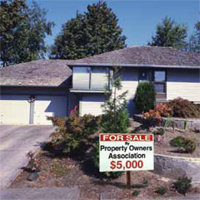
The 82nd Texas Legislature implemented a number of changes to the way POAs regulate the use of property within a subdivision. Most of the changes became effective Jan. 1, 2012. To a great extent, POAs may still regulate use of the owner’s property, but only in a reasonable manner as described by the statutes.
Jul 20, 2012
Reining in POAs
From political signs to solar panels to flagpoles, new state legislation mandates ways in which property owners’ associations can and cannot restrict property use.

Subdivision property owners frequently complain about abuses by property owner associations (POAs). Serious complaints garner legislative attention. The 82nd Texas Legislature passed ten bills limiting the powers and procedures of POAs.
Foreclosure Procedure Changes
Following POA foreclosure abuses in the early 2000s, the 78th and 79th Texas Legislatures changed the way POAs foreclose liens. The changes occurred in 2002 and again in 2005 (see Center publication 1548, “Legislature Limits POA Power”). The latest legislation made even more changes to the foreclosure process.
Prior to Jan. 1, 2012, POAs could foreclose on liens nonjudicially. Now, the law requires judicial foreclosure except when the property owner waives the requirement in writing.
Before Jan. 1, 2012, POAs could not foreclose on liens when the debt securing the lien consisted (1) solely of fines and assessments or (2) of attorney fees associated solely with the fines and assessments. A third element was added effective Jan. 1, 2012. Now, POAs may not foreclose to recover any costs for compiling, producing or reproducing requested information regarding materials contained in the POA’s books and records when the costs are added to an owner’s account as an assessment.
Prior to Jan. 1, 2012, POAs were required to give delinquent owners details of the amount due and a 30 day opportunity to cure the delinquency before any collection procedures began. Owners had to be informed of their right to request a hearing. Now, the notices also must include any special rights active duty military owners may have under the Federal Service Members Civil Relief Act.
After Jan. 1, 2012, POAs must send notices to all subordinate lienholders as well as to the delinquent owners noted previously. The notice, indicating the total amount of the lien, must be sent by certified mail, return receipt requested, to the address shown in the deed records. The inferior or subordinate lienholder(s) has 61 days after receiving the notice to cure the delinquency and avoid foreclosure.
Alternative Payment Plans
The Texas Property Code (TPC) now requires all POAs consisting of more than 14 lots to adopt reasonable guidelines for collecting delinquent assessments or other amounts owed. The guidelines, known as the alternative payment schedule or simply “the plan,” require POAs to give delinquent property owners the option of making partial payments over a three- to 18-month period starting from the time the property owner makes the request.
The plan must be free of any “monetary penalties,” but may include interest and reasonable administrative costs. The association may deny the plan to anyone who has defaulted on a previous one during the last two years.
The plan must be filed in each county where the subdivision is located. However, failure to file does not disqualify the association from offering the plan to anyone in default.
The new statute mandates that payments collected under the plan be applied in the following order to:
- delinquent assessments,
- current assessments,
- attorney fees or third-party collections costs incurred solely with assessments or other charges that could be the basis for foreclosure,
- all other attorney fees that cannot be the basis for foreclosure,
- assessed fines and
- other amounts owed the association
However, the allocation does not apply if the property owner is in default under the plan when the payment is received. An assessed fine, when collected, can never be applied to a higher category than the one listed.
The new law addresses the association’s use of “collection agents” as defined in the Federal Fair Debt Collection Practices Act (15 United States Code, Section 1692a). There are three limitations.
First, the property owner cannot be held liable for a collection agent’s fees unless written notice is first given to the owner by certified mail, return receipt requested. The notice must contain:
- the amount in default and the total needed to bring the account current,
- the options available to the owner to avoid having the account turned over to a collection agent, including the availability of the alternative payment plan discussed earlier and
- a 30-day opportunity to cure the amount in default before any action will be taken to collect the delinquency.
Second, the property owner can never be liable for a collection agent’s fees when:
- the obligation to pay the collection agent is dependent or contingent, in any way, on the amounts recovered or
- the entire amount collected goes to the collection agent for his or her services.
Third, although no remedies are specified in the statute, the arrangement between the association and the collection agent may not prohibit the property owner from contacting the association’s board or the association’s managing agent directly regarding the delinquency.
In a related matter, the POA may not sell or otherwise transfer an interest in the association’s accounts receivable except as collateral for a loan.
Flags and Flagpoles
Effective May 23, 2011, POAs may not adopt or enforce dedicatory instrument provisions (deed restrictions) that prohibit, restrict or affect an owner’s right to display the U.S. flag, the Texas state flag or an official or replica flag of any branch of the U.S. Armed Forces.
However, the POAs may require:
- the U.S. flag be displayed in accordance with the federal rules found in 4 United States Code Annotated, Sections 5–10,
- the Texas state flag be displayed in accordance with the rules found in Chapter 3100 of the Texas Government Code,
- the flagpole be constructed of permanent, long-lasting materials with a finish appropriate and harmonious with the dwelling,
- the display of the flag or the location and construction of the flagpole comply with applicable zoning ordinances, easements and setback requirements and
- the displayed flag and flagpole be maintained in good condition. Any deteriorated flag or deteriorated or structurally unsafe flagpole must be repaired, replaced or removed.
Likewise, POAs may regulate:
- the size, number and location of flagpoles (POAs must allow the installation and erection of at least one 20-foot or shorter flagpole per property;
- the size of a displayed flag;
- the size, location and intensity of lights used to illuminate the flag; and
- the noise caused by an external halyard on the flagpole.
POAs may prohibit property owners from locating a flag or flagpole on property owned or maintained by the POA or on land owned in common by the members of the association.
Solar Panel Installation
Effective May 29, 2011, POAs may not include or enforce provisions that prohibit or restrict property owners from installing a “solar energy device.” The term is defined as a system or series of mechanisms designed primarily to provide heating or cooling or to produce electrical or mechanical power by collecting and transferring solar-generated energy (Section 171.107, Texas Tax Code). This includes a mechanical or chemical device that can store solar-generated energy for use in heating or cooling or in the production of power.
There are exceptions. The new law allows POAs to include and enforce provisions that prohibit solar energy devices that:
- threaten the public health or safety or are in violation of the law as adjudicated by a court,
- are located on property owned or maintained by the POA or owned in common by the members of the association,
- are located anywhere other than on the homeowner’s roof or on the roof of a permitted structure on the property or in an area other than a fenced yard or patio maintained by the property owner,
- are installed without prior approval by the POA or a committee created to make such decisions or
- void material warranties when installed.
The statute expands regulation of solar energy devices installed on roofs. The top edge of the device must be parallel to and no higher than the roofline. The device must conform to the slope of the roof. The color of the frame, support brackets and visible piping or wiring must be silver, bronze or black tones.
Solar energy devices installed on the roofs may be located in an area other than the one designated by the POA if the estimated annual energy produced at the alternate location increases production by more than 10 percent. The estimate must be based on modeling tools provided by the National Renewable Energy Laboratory.
Solar energy devices located in fenced yards or on patios cannot exceed the height of the fence.
The POA or the association’s architectural committee may not withhold approval of installation of any solar energy device that conforms to these statutory guidelines, with two exceptions.
(1)The POA or the committee may prohibit or restrict a property owner from installing a solar device during the “development period.” This is the time during which the declarant (developer) reserves the right to (a) facilitate the development, construction and marketing of the subdivision and (b) direct the size, shape and composition of the subdivision.
(2) The POA or the committee may determine in writing that proposed placement of the device (in conformity with the statute) “substantially interferes with the use and enjoyment of land by causing unreasonable discomfort or annoyance to persons of ordinary sensibilities.” However, this determination can be overridden by all adjoining property owners giving written approval for the proposed placement.
Roofing Materials
Effective May 29, 2011, POAs may not include or enforce provisions that prohibit or restrict property owners, who are otherwise authorized to install shingles on their roofs, from installing shingles that are designed primarily to:
- be wind and hail resistant, provide heating and cooling efficiencies greater than those provided by customary composite shingles or
- provide solar generation capabilities.
Shingles meeting the above requirement must, when installed:
- resemble the shingles used or authorized for use on the property,
- be more durable than and of equal or superior quality to those authorized for use on the property and
- match the aesthetics of the surrounding property.
Displaying Religious Items
Effective May 23, 2011, POAs may not adopt or enforce restrictive covenants that prohibit a property owner or resident from displaying or affixing one or more religious items on the owner’s or resident’s dwelling. The display must be motivated by the person’s sincere religious belief.
However, POAs may prohibit the display or affixing of religious items in the exterior entry of the dwelling even when permitted by the Texas and U.S. Constitutions, if they:
- threaten public health or safety;
- violate the law;
- contain language, graphic or a display that patently offends a passerby;
- extend beyond the outer edge of the door frame of the dwelling or
- contain more than 25 square inches measured individually or in conjunction with other religious items displayed on the entry door or door frame.
Likewise, the owner or resident may not, in the name of religion, use a material or color for an entry door or door frame, or make alterations to the entry door or door frame that are not authorized by the restrictive covenants.
Finally, the POA has the authority to remove any item displayed in violation of a deed restriction permitted by the new law. It is unclear if this “removal” is a self-help remedy or one of specific performance stemming from a lawsuit.
Political Signs
While not a new law, effective Sept. 1, 2005, Section 202.009 of the TPC was amended to limit how POAs regulated the display of political signs. Basically, POAs cannot adopt or enforce restrictive covenants that prohibit owners from displaying signs advertising political candidates or ballot items in an election.
Reasonable limitations are allowed. For example, signs cannot appear more than 90 days before an election and ten days thereafter and must be ground-mounted. Only one sign per candidate is permitted (see Center publication 1548, “Legislature Limits POA Power”).
Fambrough ([email protected]) is a member of the State Bar of Texas and a lawyer with the Real Estate Center at Texas A&M University.
Did you like this Article?