
Texas’ labor market had a stronger recovery after the Great Recession than did the nation’s. Jobs created were concentrated in larger metro areas, but higher oil prices also increased Midland’s and Odessa’s job gains.
Jun 8, 2015
Texas Job Market Outpaces Nation’s
In the post-Great Recession race to create jobs, Texas did itself proud. It beat the nation as a whole.

An ongoing research program at the Real Estate Center monitors the performance of the Texas economy visà-vis the U.S. economy and other state economies in the aftermath of the Great Recession. An article in the April 2015 Tierra Grande compared the Texas economy’s recovery with the U.S. economy’s measured in terms of gross domestic product. This article reports findings regarding Texas’ share of U.S. job recovery since the end of the Great Recession.
The Great Recession (GR) was the largest economic downturn since the Great Depression. According to the Business Cycle Dating Committee of the National Bureau of Economic Research, it began in December 2007 and ended in June 2009. During this period, the U.S. economy lost 3.1 percent of its aggregate output measured in terms of gross domestic product (GDP) adjusted for inflation. But job losses were even more severe. From January 2008 to December 2009, the U.S. economy lost 8.7 million jobs or 6.3 percent of total nonfarm jobs.
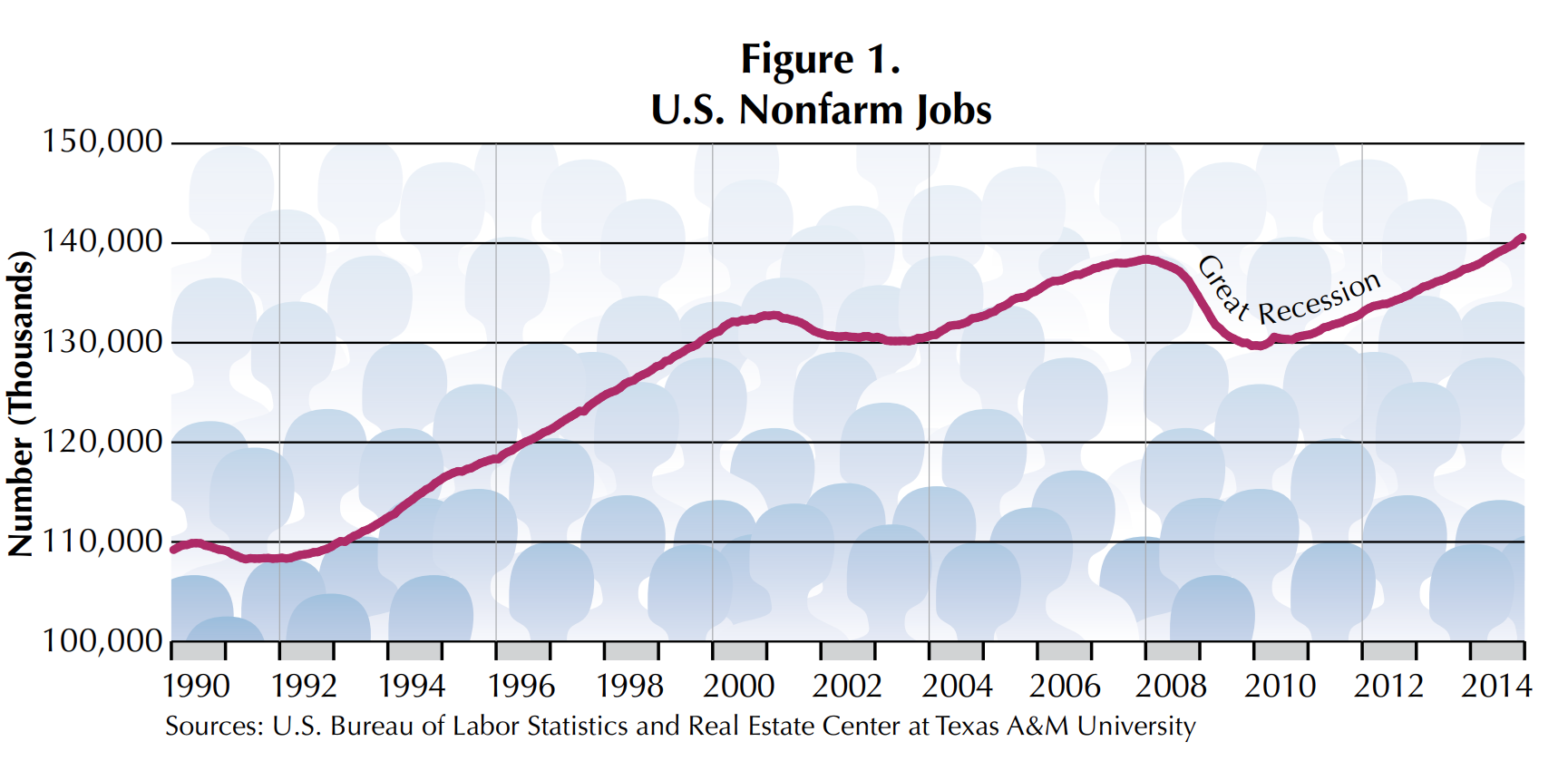
Since December 2009, the U.S. economy has had a slow and modest labor market recovery. It took about six years to recover jobs lost in the GR. In May 2014, the U.S. economy reached its prerecession peak of more than 138 million jobs (Figure 1). The most recent employment data show that the nation gained more than 10.9 million jobs from December 2009 to December 2014.
The GR was less severe in Texas than in the United States as a whole. Along with half a percent of its GDP, the state lost 431,000 or 4.1 percent of nonfarm jobs from a pre-GR peak in August 2008 to the trough in December 2009 (Figure 2). It took about two years, until November 2011, for Texas to recover jobs lost in the GR.

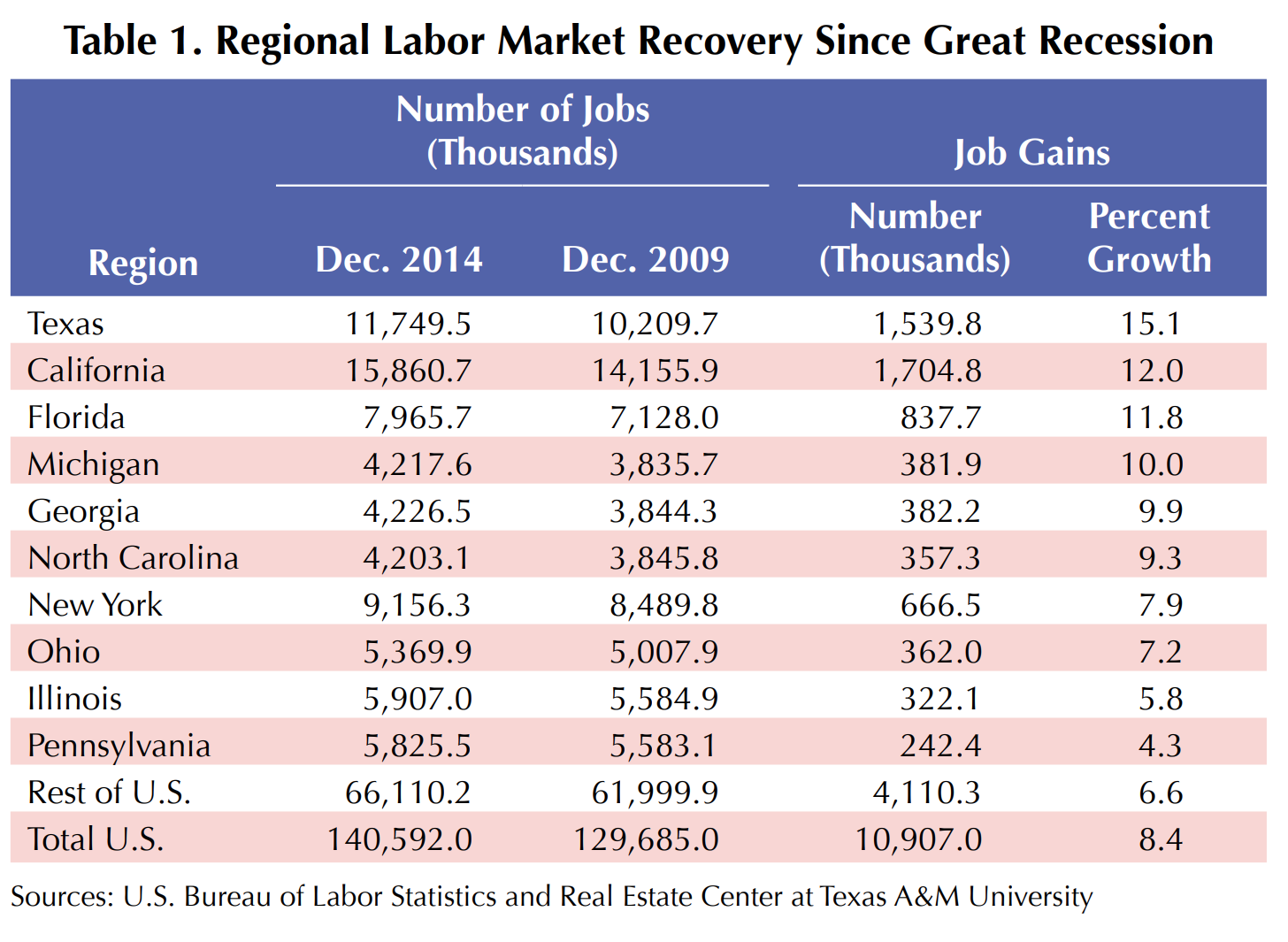
This “Texas sized” job recovery has been playing an important role in the nation’s labor market recovery from the GR. The Texas economy has created more than 1.539 million jobs since December 2009, a 15.1 percent growth rate, ranking first among U.S. states in job growth rate (Table 1).
Texas’ share of U.S. jobs increased from 7.9 percent in December 2009 to 8.4 percent in December 2014 (Figure 3). As a result of a higher-than-national average employment growth rate, Texas’ share of U.S. jobs increased at the expense of New York’s and California’s share of jobs (Figure 3). Texas’ share of U.S. jobs exceeded that of New York in 1994. The gap between Texas and California is narrowing.

Sources of Texas Job Recovery
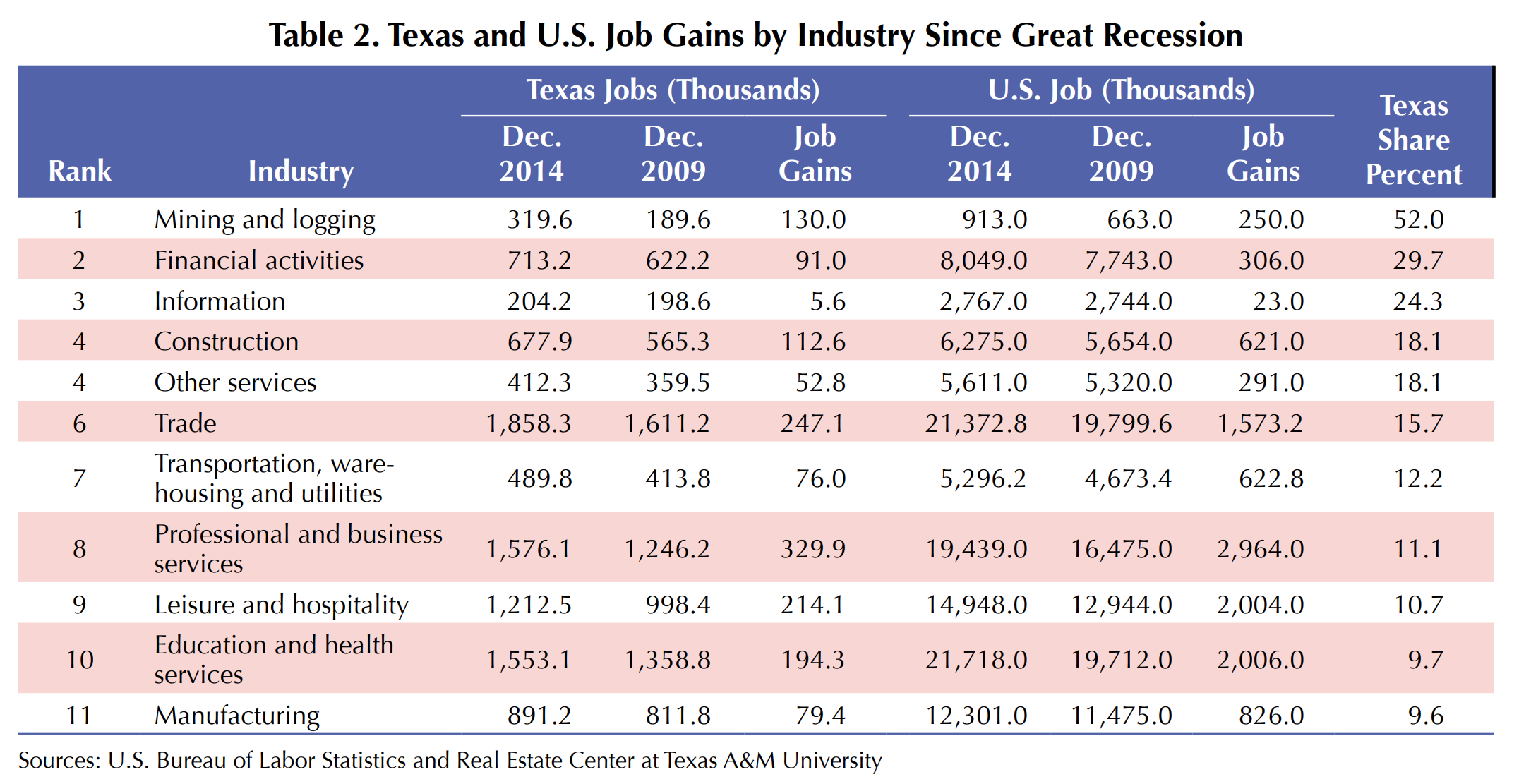
Texas’ total job gains since the GR is the sum of net job gains by its industries. Table 2 shows Texas industries ranked by their shares of U.S. job gains since the end of GR. The state’s mining and logging industry created 52 percent of mining jobs and ranked first in job creation followed by financial activities, information and construction. In terms of the number of jobs, the state’s professional and business services industry, by creating 329,900 jobs, ranked first followed by the trade industry, leisure and hospitality, and education and health services (Table 2).
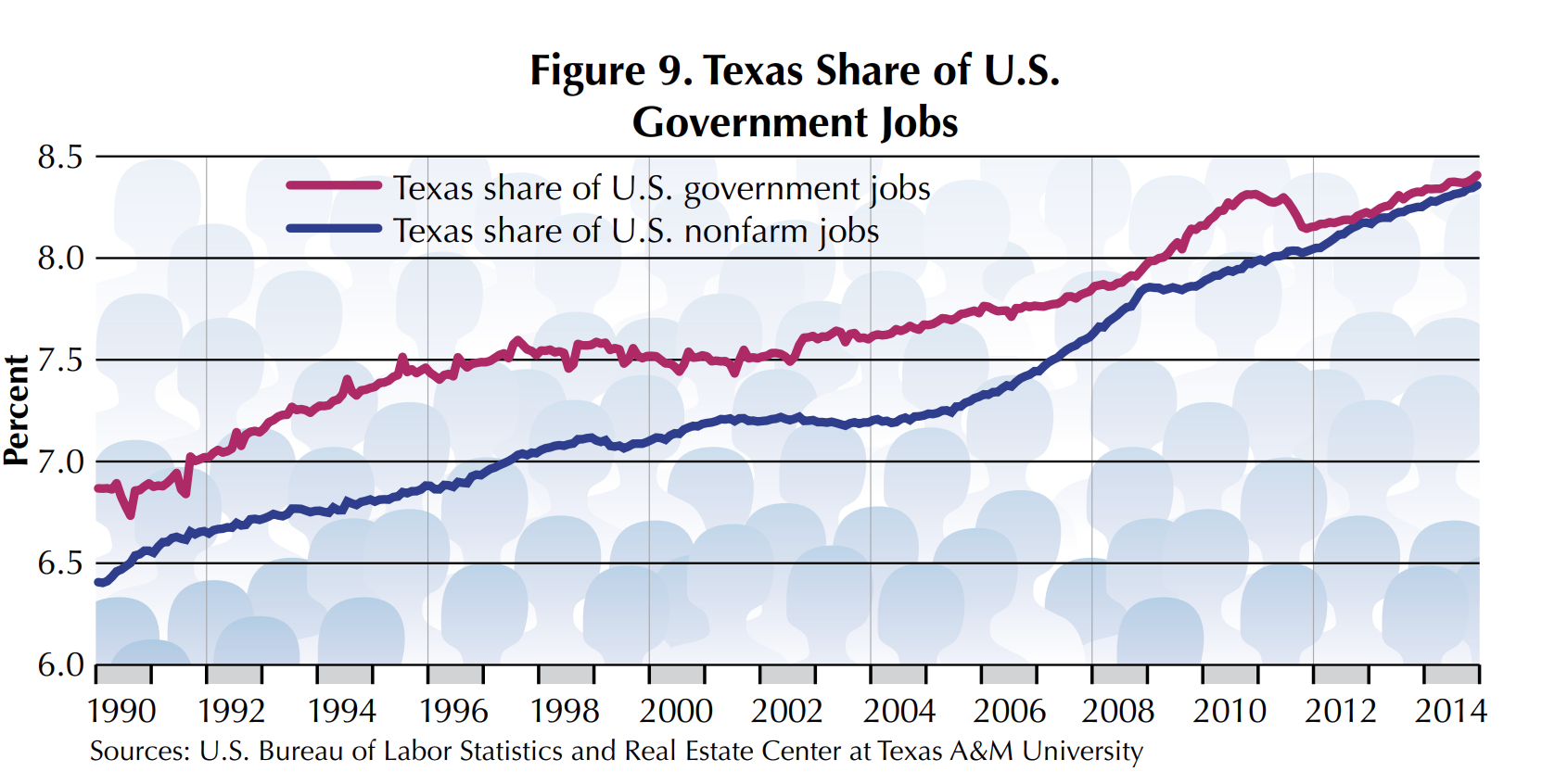
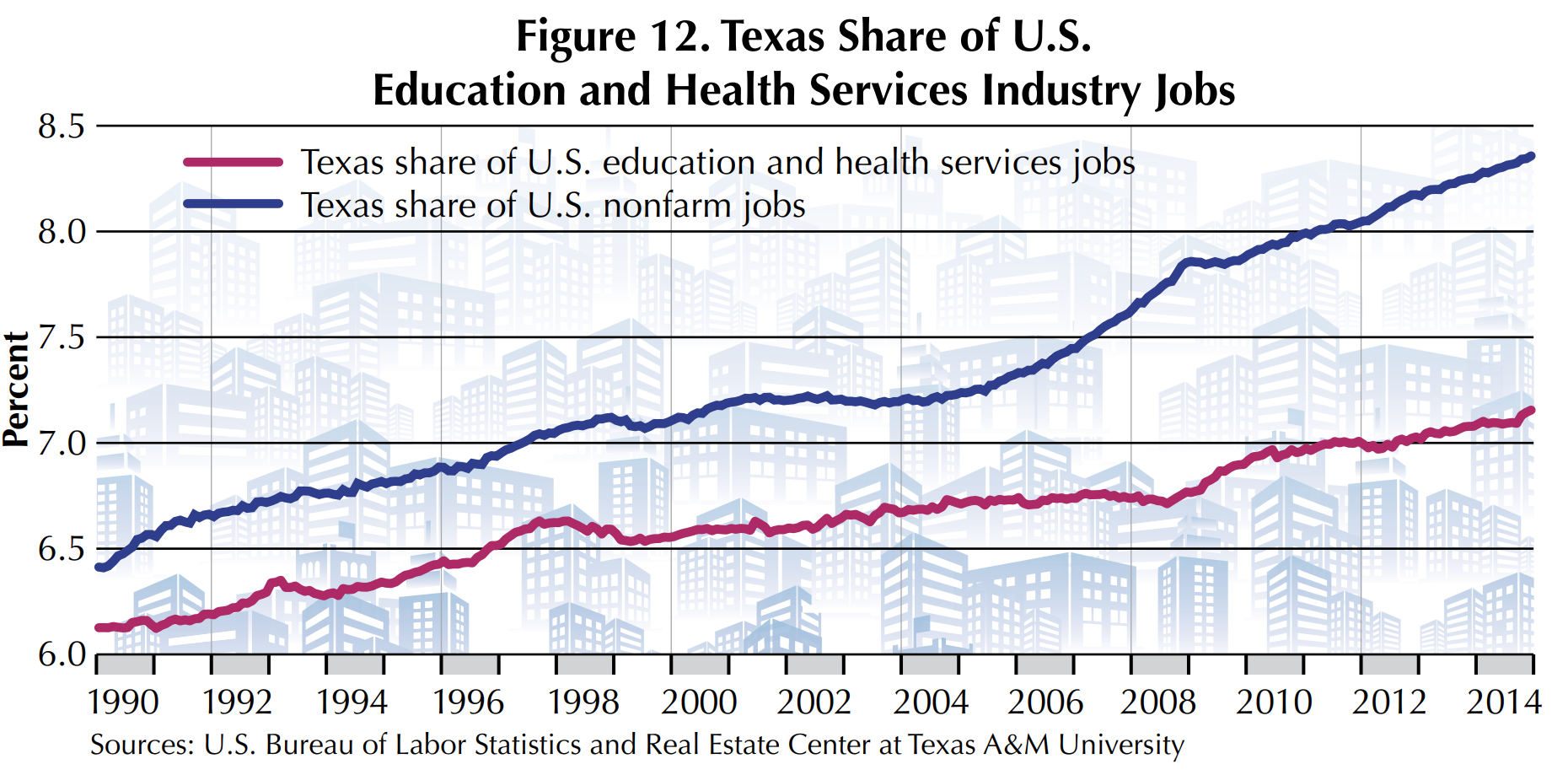
Texas’ stronger job market recovery has enhanced the long-term upward trends in the state’s share of U.S. jobs by industry. All Texas industries expanded their shares of U.S. jobs since the end of the GR, but the expansion rates varied across industries. Texas’ share of jobs in the state’s mining and logging industry, construction, financial activities, trade, transportation, warehousing and utilities, and the government sector have been greater than the state’s share of U.S. nonfarm jobs (Figures 4 to 9). The state’s shares of manufacturing, professional and business services, education and health services, leisure and hospitality, and other services industries have been less than the state’s shares of nonfarm jobs (Figures 10 through 14).
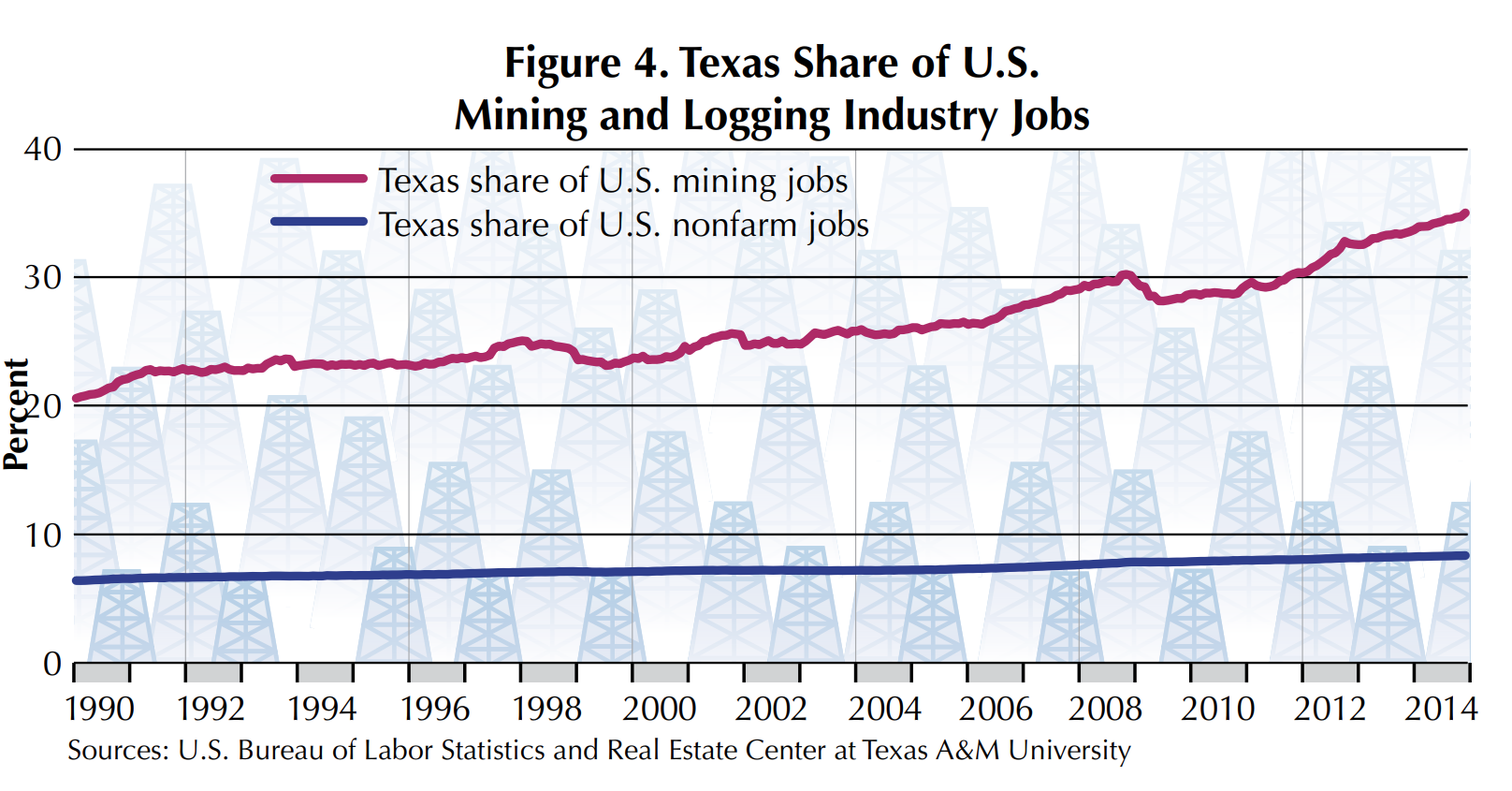
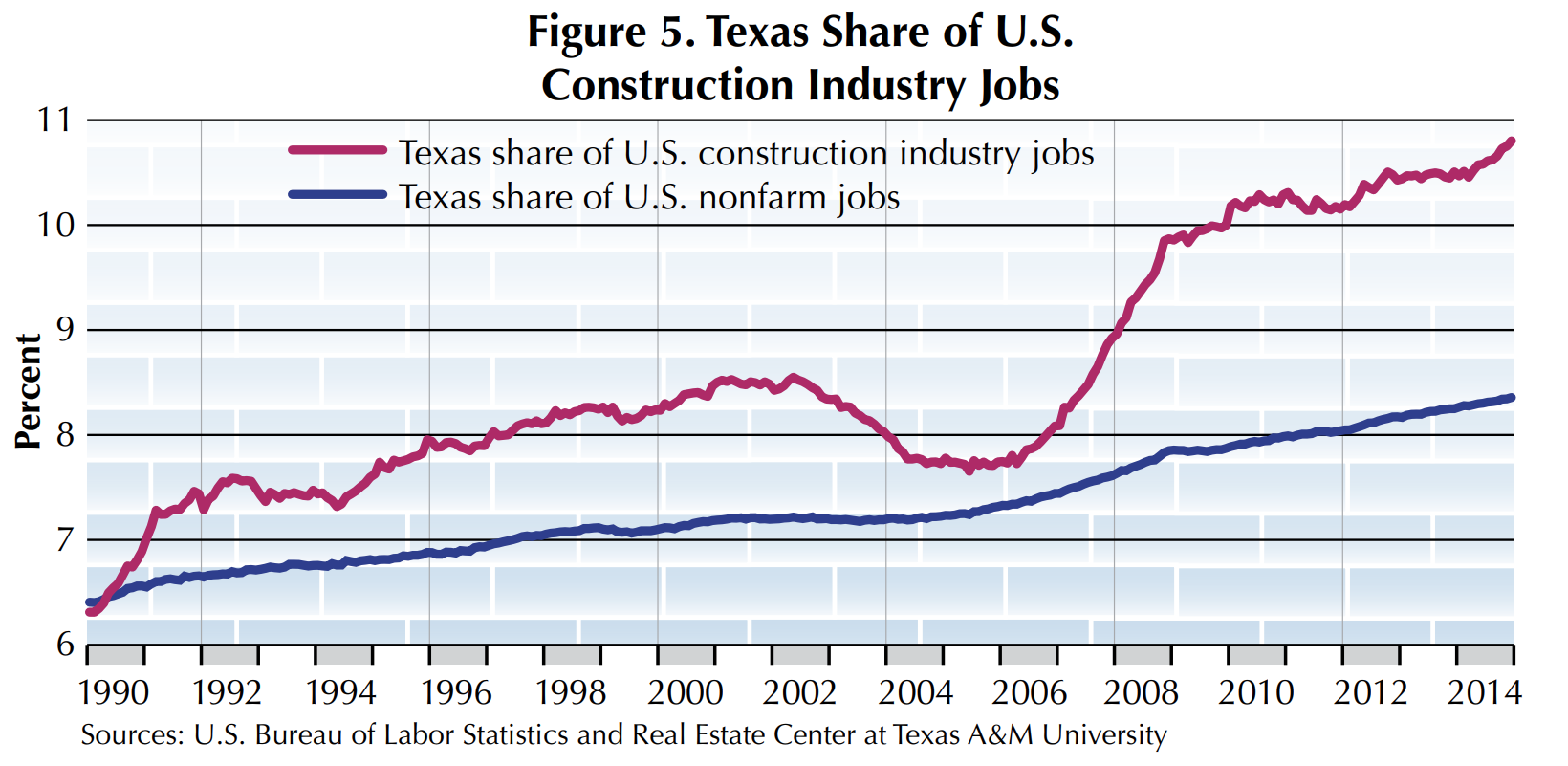


Helped by higher oil prices, Texas’ mining and logging industry experienced the largest increase in share of U.S. mining jobs, from 28.6 percent in December 2009 to 35 percent in December 2014, well above the state’s share of U.S. nonfarm jobs (Figure 4). Texas’ share of U.S. construction jobs expanded rapidly in the GR, but the expansion rate has slowed since 2010 (Figure 5). Texas’ share of financial activities jobs has exceeded the state’s shares of nonfarm jobs since 1999 and reached 8.9 percent in December 2014 (Figure 6). Texas’ share of U.S. trade industry jobs has moved alongside and above the state’s shares of U.S. nonfarm jobs, reaching 8.7 percent in December 2014 (Figure 7). The state’s transportation and utilities industry posted a steady long-run upward trend and expanded its share of U.S. jobs from 7.1 percent in December 1990 to 9.2 percent in December 2014 (Figure 8).

Texas’ shares of government jobs after the GR were higher than the state’s shares of U.S. nonfarm jobs until 2012. Since then, the gap between the state’s share of U.S. nonfarm jobs and its share of U.S. government jobs has been narrowing (Figure 9). Texas’ share of U.S. manufacturing jobs has moved alongside and below its share of U.S. nonfarm jobs, reaching 7.2 percent in December 2014 (Figure 10).

The long-run upward trend in Texas’ share of U.S. professional and business services jobs accelerated from 6.8 percent in December 2004 to 8.1 percent at the end of 2014 (Figure 11). Another long-term upward trend expanded Texas’ share of U.S. education and health services industry jobs to 7.2 percent in December 2014 (Figure 12).

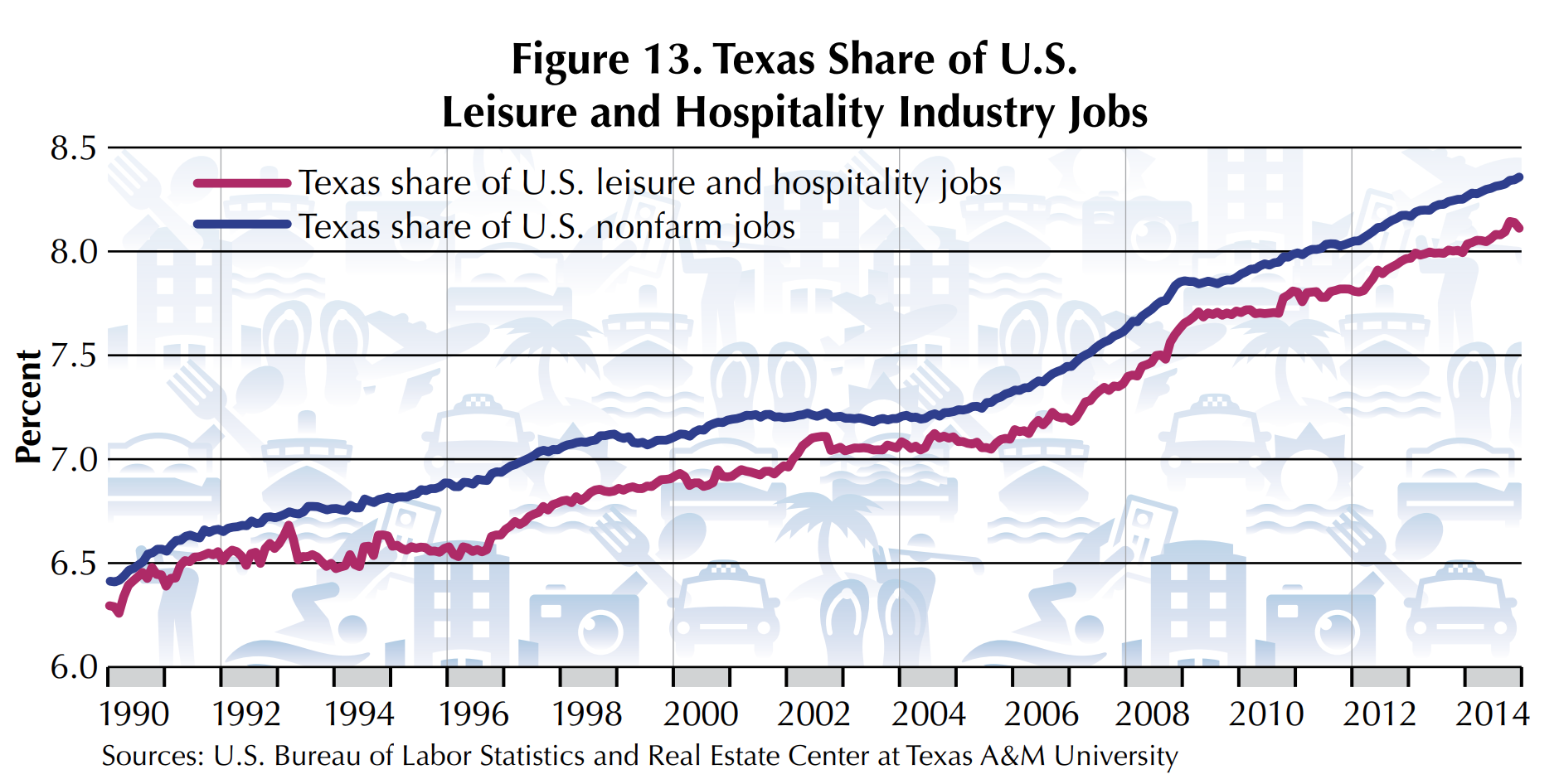
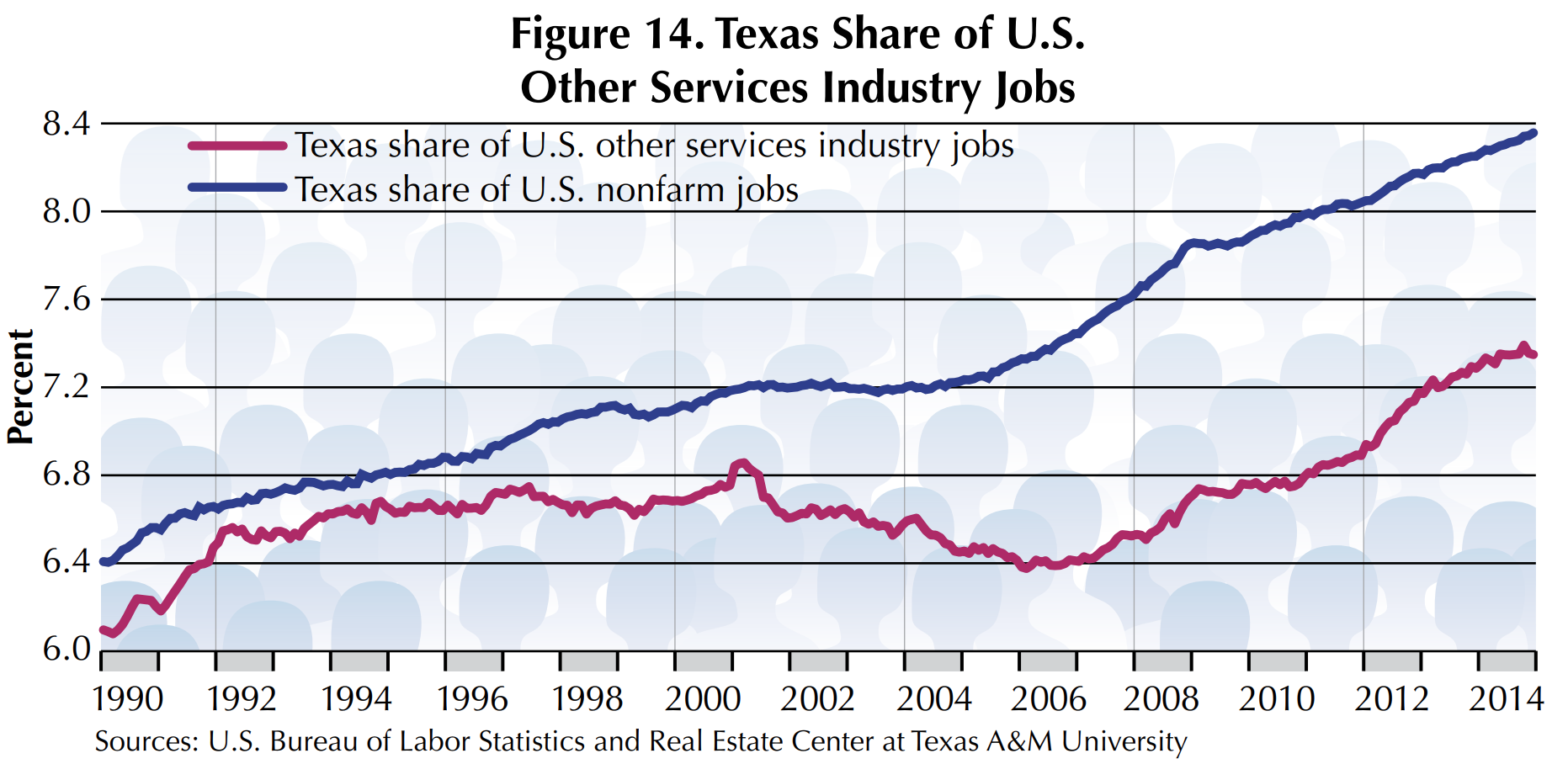
The state’s share of leisure and hospitality jobs was lower than its share of the U.S. nonfarm jobs at 8.1 percent in December 2014 (Figure 13). Texas’ share of the U.S. other services industry has trended upward since 2006, reaching 7.3 percent in December 2014 (Figure 14). The state’s information industry, which suffered job losses in the aftermath of the bursting of the dot.com bubble in the early 2000s, expanded its share of U.S. jobs to 7.4 percent at the end of 2014 (Figure 15).

Job Recovery by Metropolitan Areas
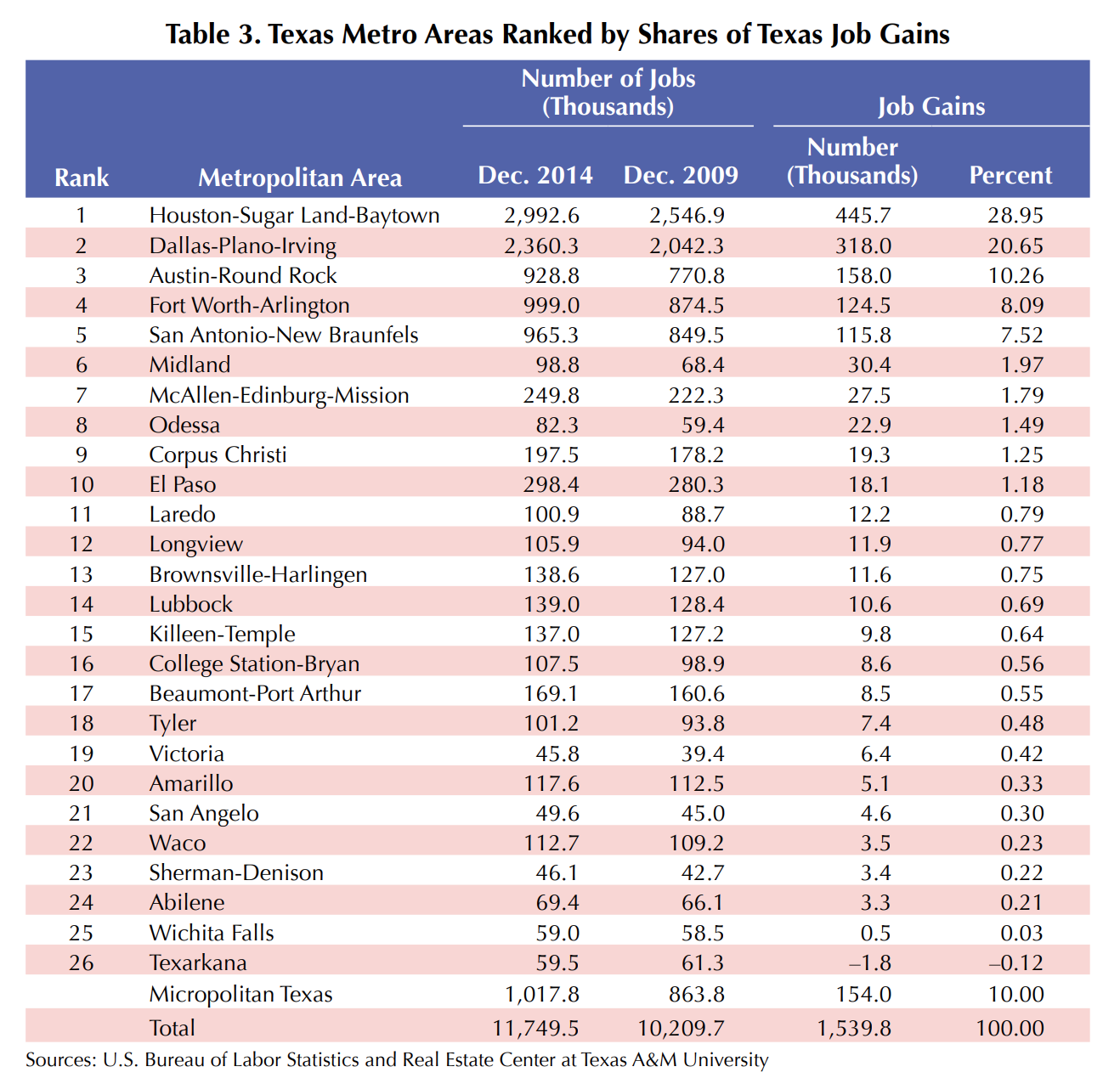
Texas job gains are the sum of job gains of the state’s local economies (Table 3). Houston-Sugar Land-Baytown ranked first in the state’s labor market recovery, accounting for 28.95 percent of the state’s job gains from 2009 to 2014, followed by Dallas-Plano-Irving (20.65 percent), Austin-Round Rock (10.26 percent), Fort Worth-Arlington (8.09 percent), and San Antonio-New Braunfels (7.52 percent). Although larger metropolitan areas generated more jobs, higher oil prices boosted job gains in Midland and Odessa.
Texas Job Gains and the State’s Real Estate Industry
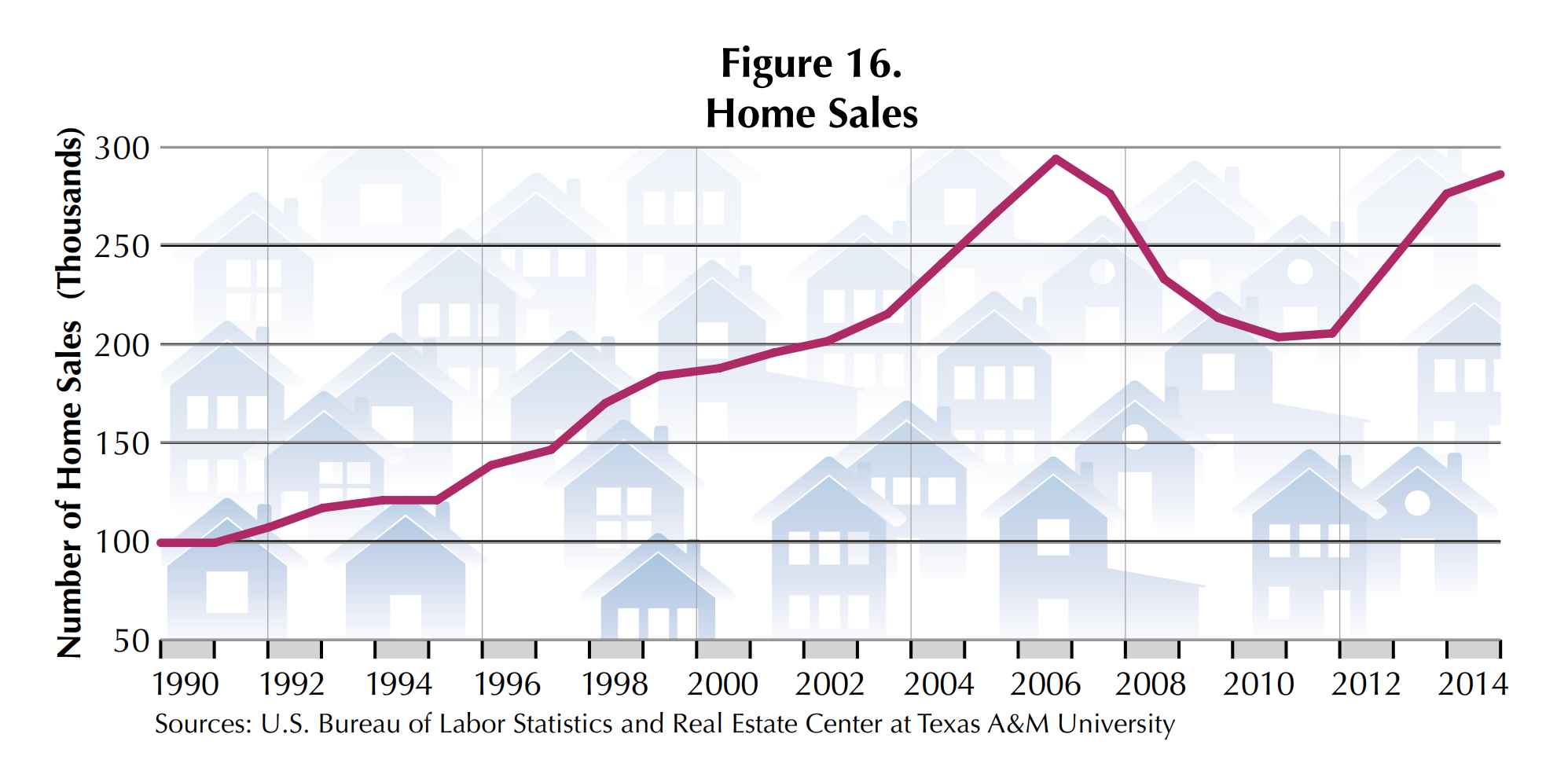
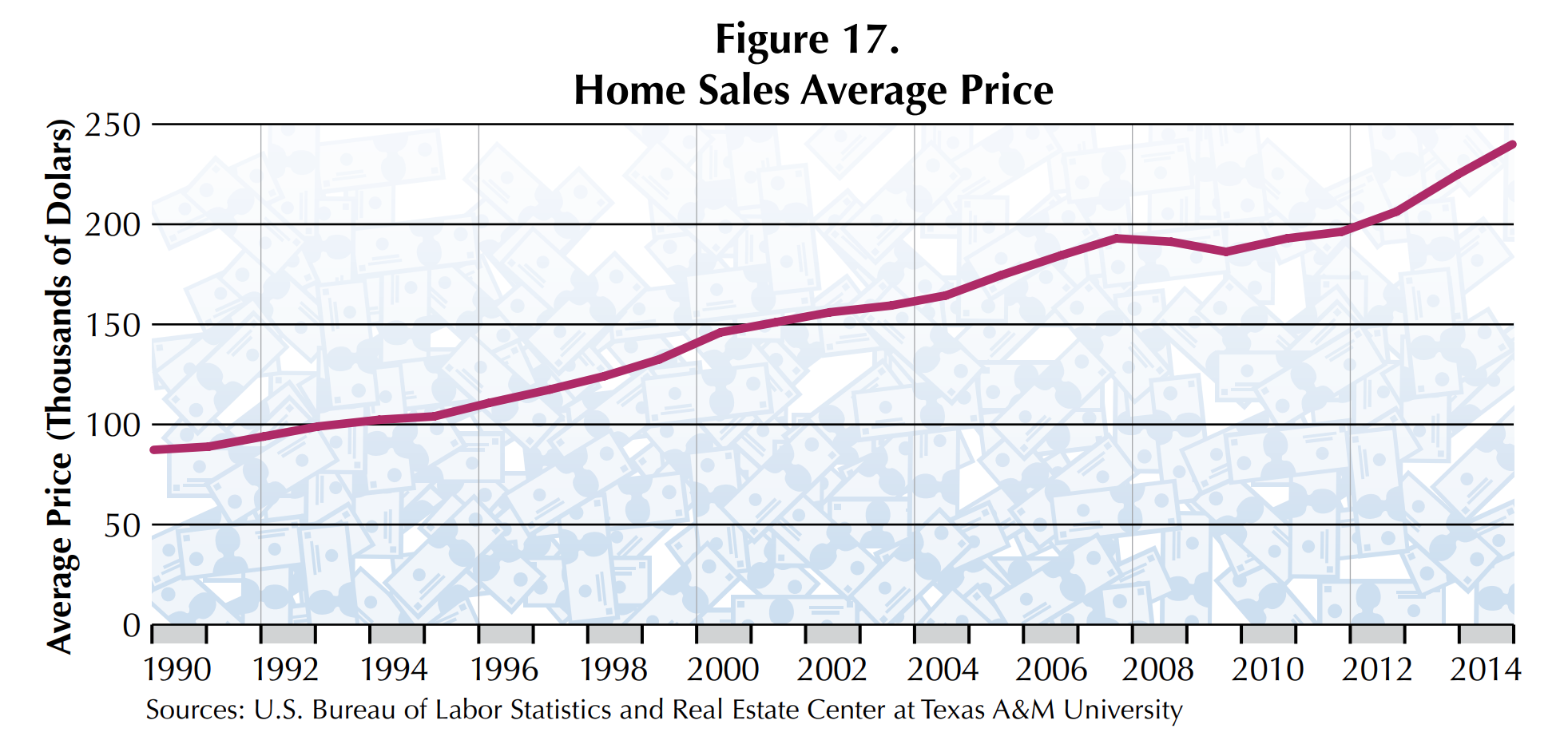
Texas post-GR job gains have helped both Texas home sales and home prices to rebound from the GR. The number of homes sold increased from 203,637 units in 2010 to 285,111 in 2014, a 40 percent increase (Figure 16). The average Texas home price increased by 24.7 percent, from $192,300 in 2010 to $239,800 in 2014 (Figure 17).
Texas’ labor market recovery has been stronger than the nation’s, attracting more people and companies to Texas and increasing demand for all types of real estate properties. As Texas’ shares of U.S. jobs by industry demonstrate, the state’s job gains are broad based, leading particularly to more demand for commercial and industrial real estate properties in Texas.
As to the future, the Texas economy is expected to continue generating more jobs but at a slower pace because of falling oil prices. Since June 2014, the state’s oil and gas extraction industry has curtailed its investment expenditures. As in the past, the state’s economy is expected to weather the current oil price collapse in the longer term, but 2015–16 will be a challenging period and a test of its strength.
Dr. Anari ([email protected]) is a research economist with the Real Estate Center at Texas A&M University.
Did you like this Article?

You might also like


4 minute read
Dec 01 2020
Checking Out
Leisure and Hospitality Industry's Struggle
COVID-19 was a nightmare guest for the state’s leisure and hospitality industry in 2020, virtually shutting down hotels, restaurants, and entertainment venues and putting hundreds of thousands out of work. The sector is still recovering from the labor pains.


