Texas Land Market Developments: Second Quarter — 2003
Prices paid for Texas rural land rose strongly in the first and second quarters of 2003 compared with price levels in 2002. This reports tells why buyers were buying and where the more popular shopping happened.

Prices paid for Texas rural land rose strongly in the first and second quarters of 2003 compared with price levels in 2002. The strong performance relied on a combination of recreational buyers and investors. Low interest rates and meager returns on alternative investments prompted the latter group to view rural land as a viable alternative.
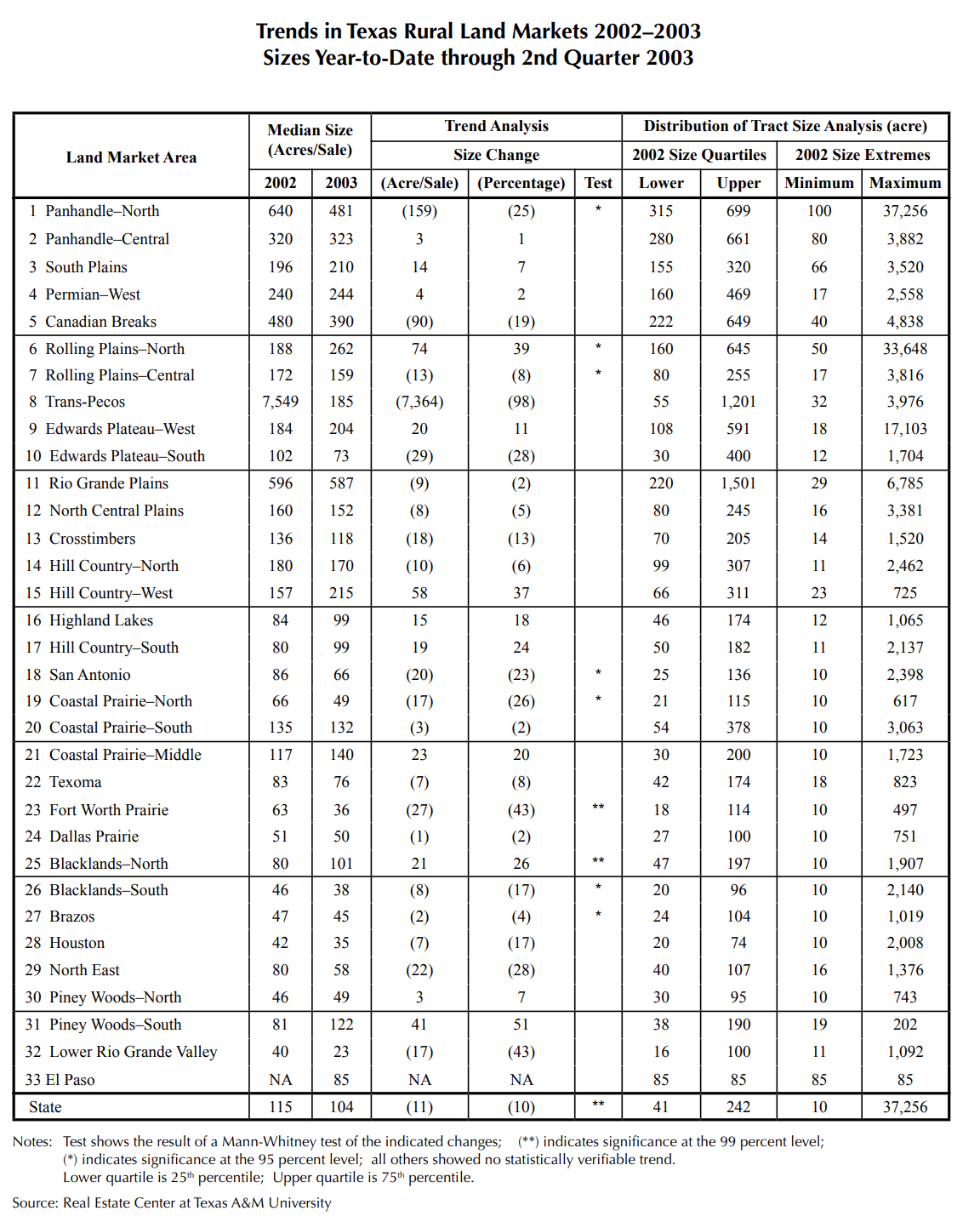
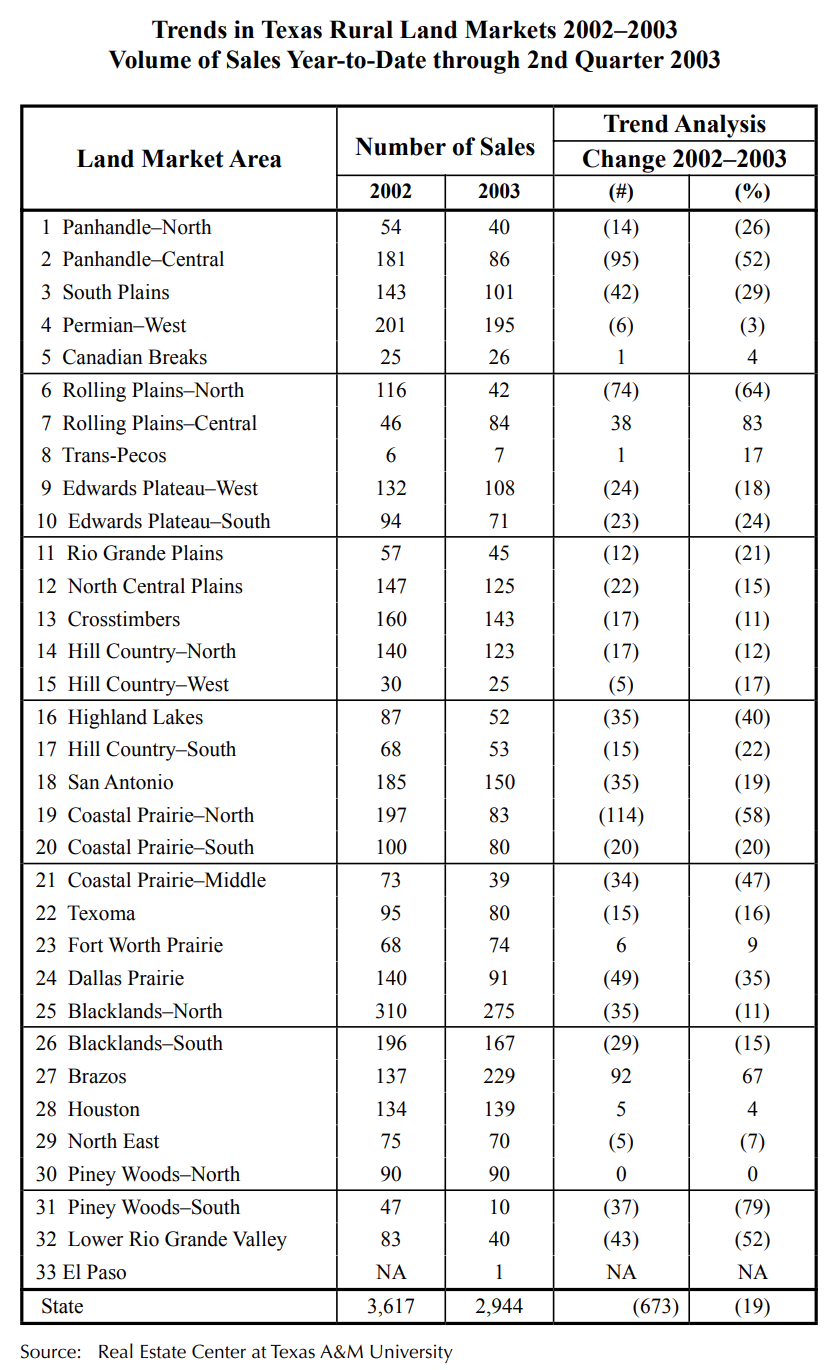
Recreational buyers, consisting mostly of those seeking hunting properties, have fanned out into areas of the Panhandle and West Texas. Buyers are finding it more difficult to locate suitable properties at affordable prices in traditionally popular spots, such as the Hill Country and South Texas. As a result, buyers have migrated to an area from Abilene to Amarillo and have begun to ferret out suitable properties in prairie areas passed over by hunters in the past. These forces have combined to produce the sizable increases shown in the following tables.
Statewide
- Prices rose 13 percent from $974 per acre in 2002 to $1,111 per acre in 2003.
- Nearly all areas with significant price changes had sizable increases.
- The sizes of properties sold dropped in most areas.
- Investment demand surfaced as a motive for a growing segment of the market.
- Recreational demand continues to drive rural land markets across Texas.
- Recreational demand is on the increase in more remote markets. Buyers appear to be resisting high priced land in traditionally hot markets. They are willing to travel farther for lower-priced land.
- Agents report a shortage of good land for sale in most areas.
- Low interest rates continue to attract buyers.
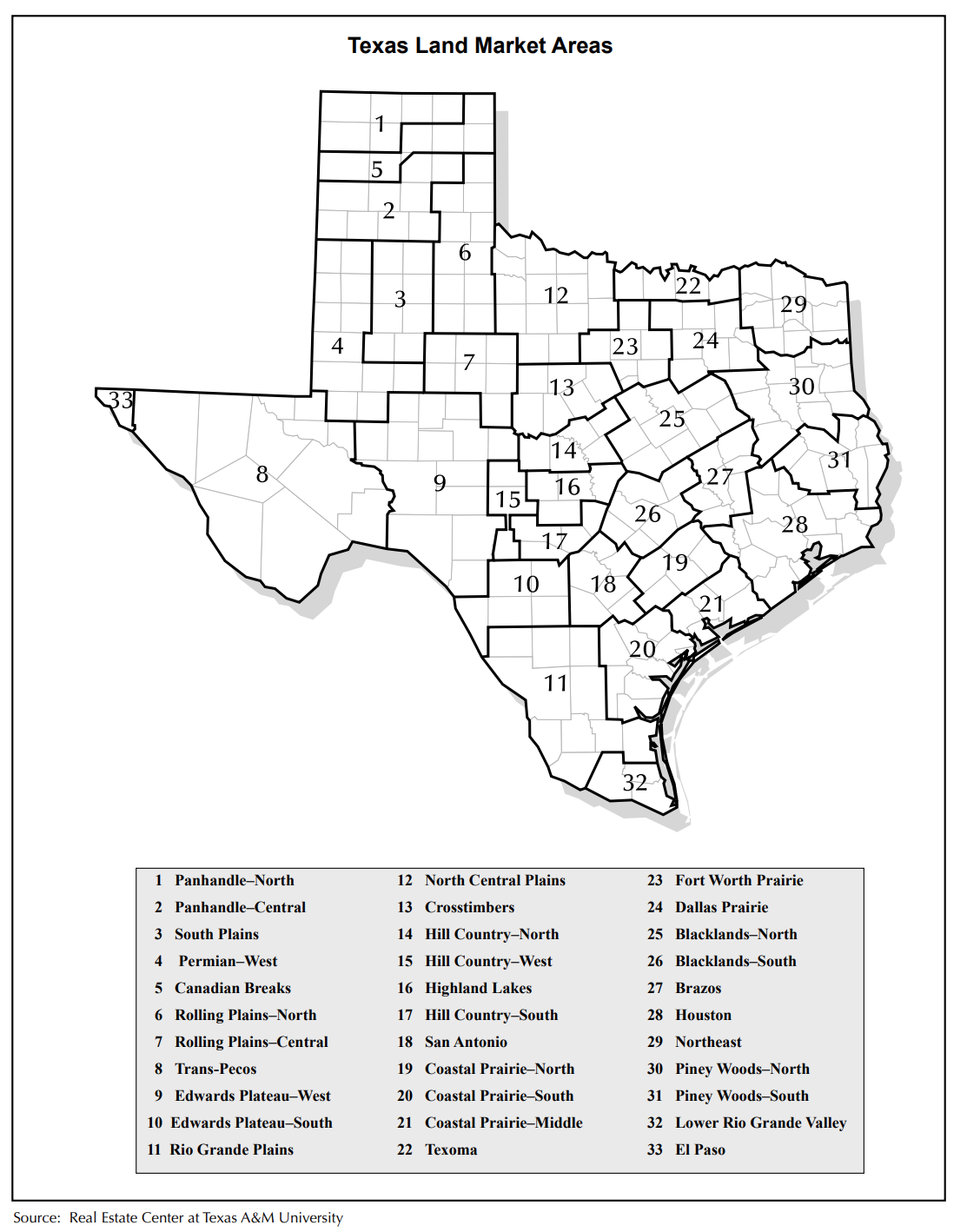
- The following land market areas (LMAs) registered especially strong trends compared with markets in first half 2002.
LMA 1
- The 2003 median price per acre dropped below the 2002 price. However, prices had increased dramatically between 2001 and 2002, and this apparent drop represents an adjustment from that large jump. This region’s dynamics reflect the same forces that are influencing the remainder of the Panhandle (LMAs 2 through 6).
LMAs 2 through 6
- Recreational demand for land has reached the Panhandle, with buyers flocking to the region searching for hunting properties.
- Many recreational buyers have abandoned hunting leases in other regions and are seeking more control of their hunting venues.
- Brokers continued to face a rising volume of inquiries from quail and deer hunters living in metropolitan areas of Texas.
- Sparked by low returns on alternative investments, some buyers are parking capital in land, adding to the total demand in this region.
- The 2002 Farm Bill eased possible negative pressure on farmland prices.
LMA 7
- Demand for property is coming from buyers in the Dallas–Fort Worth Metroplex, Austin and Houston who want the land for bird and white-tailed deer hunting.
- Property is being bought in large tracts (2,000 to 3,000 acres) and then divided into smaller tracts and resold. This activity is occurring most frequently in Taylor and Coleman Counties.
- Demand is substantial enough that there is not enough land for everyone who wants it.
LMA 18 and 19
- Prices in the Hill Country have spiraled to such high levels that buyers are shifting their focus to overlooked alternatives. Areas where local buyers traditionally populated markets now have competition from outsiders seeking out hunting properties. Karnes, Live Oak and Bee Counties are seeing prices rise to new highs.
- Anticipation of development resulting from the Toyota plant has had a significant impact on land prices south of San Antonio.
- Bird hunting has emerged as an important influence in this region.
LMA 23
- Outmigration from the Metroplex has led to increased demand for rural land.
LMA 26
- Activity has slowed in Travis and Hayes Counties, but sales in Bastrop, Lee, Caldwell, Milam and eastern Williamson Counties have increased.
- Sales in these counties continue to put upward pressure on the median price per acre.
LMA 27
- Demand for recreational land is on the rise in all parts of this area.
- Counties in the southern and eastern part of the region— Madison, Grimes and Brazos — have posted increased sales volume and higher prices. This trend stems from an influx of demand from both the Bryan–College Station and Houston areas.
- New owners are transforming the land into high-fence hunting properties and weekend retreats.
LMA 28
- The pressures of urban living in the Houston area have sent buyers flocking to the countryside, leading to a substantial rise in land prices.
LMA 29
- The price increase reflects a continuing migration out of Tyler. People leaving Tyler are seeking smaller, more rural communities and school districts.