
Jan 23, 2003
Texas Land Market Developments, Third Quarter 2002
Texas land markets regained momentum in third quarter 2002, with prices in most local markets on the increase. This report analyzes sales using data reported to the Real Estate Center.

Texas land markets regained momentum in the third quarter after registering an uncharacteristic dip in the second quarter (see chart). Market dynamics indicate a steady-to-increasing 2002 market with a normal volume of sales. Other than some regional anomalies related to specific short-term influences, land prices in most local markets were on the increase through fall 2002. This is an analysis of the sales reported to the Real Estate Center.
Statewide
- In the first and second quarters, tract size of sold properties increased, leading to lower per-acre prices.
- The size increase led to an uncharacteristic dip in the second quarter per-acre price.
- Third quarter sizes were more typical, restoring higher per-acre prices.
- Recreational demand continues to drive rural land markets.
- Recreational demand is increasing in more remote markets. Buyers appear to be resisting high priced land in traditionally hot markets. They are willing to travel farther for lower priced land.
- Agents report a shortage of good land for sale in most areas.
- Low interest rates continue to attract buyers.
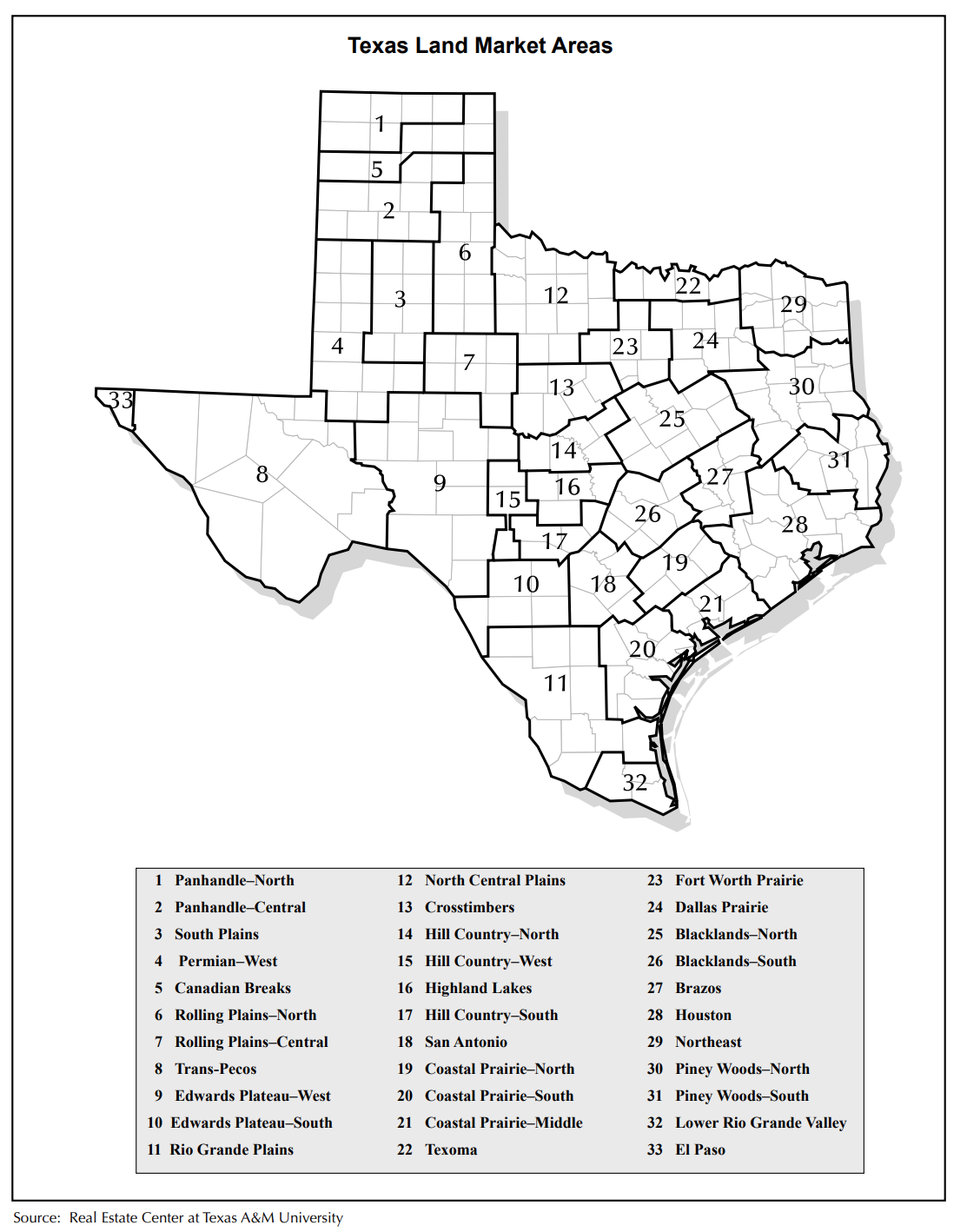
- The following land market areas (LMAs) registered especially strong trends.
- Increasing prices: (LMA 1, LMA 6, LMA 9, LMA 14 and LMA 15. See map.)
- Increasing prices in the Panhandle–North (LMA 1) resulted from a short supply of desirable land for recreational buyers.
- Speculative purchases of land to acquire water rights also contributed to the upward trend.
- With a 40 percent increase in prices, Panhandle–North ranked as one of the hottest markets in Texas.
- The quest for quail hunting retreats drove much of the activity in Panhandle–North and Rolling Plains–North (LMA 6).
- A short supply of and high demand for rangeland contributed to price increases in Edwards Plateau–West (LMA 9).
- Buyers are resisting high prices in Kerrville (LMA 17) and Fredericksburg (LMA 16) regions, preferring to trade off increased travel time for cheaper land prices.
- Prices rose throughout the Hill Country–North (LMA 14), but sales volume lagged.
- Both prices and sales volumes in Hill Country–West (LMA 15) rose dramatically.
- Weaker prices (LMA 12, LMA 23 and LMA 30)
- North Central Plains (LMA 12):
- Sales of unusually large properties contributed to a decline in median per-acre price.
- Large acreage sales resulted from the sale of ranches held by the same owners for a number of years.
- Despite the decline in median price, observers indicate a solid underlying market.
- Fort Worth Prairie (LMA 23):
- Weakness in this area stems from anticipated annexations by the City of Fort Worth. The resulting uncertainty has had a chilling effect on land markets. This effect should be temporary, easing when plans become more certain.
- Recreation purchases remain strong in Parker and Wise Counties.
- Piney Woods–North (LMA 30):
- Price deterioration in this area results from poor economic conditions in the timber business.
- Despite lower timber contributions to prices, the underlying land value has reportedly increased.
- Excess supplies of large acreages offered by major timber companies have contributed to the decline in price per acre.
- Large tract buyers are cutting them into smaller tracts for resale.
- The decline carried over into Louisiana.
- North Central Plains (LMA 12):
- Increasing prices: (LMA 1, LMA 6, LMA 9, LMA 14 and LMA 15. See map.)


Did you like this Article?


