
Texas ranks second nationally in the number of foreign-born residents, who currently make up more than one-fifth of the state’s population. That segment of the population is changing along with the skills of its workforce.
Feb 21, 2019
The New Texans
In recent years, Texas has welcomed a steady flow of international immigrants—not just from Mexico but from as far away as India, China, and the Philippines. Read how these new neighbors are changing the face of Texas and brining diverse skills to the workforce.

Texas’ economic success after the Great Recession attracted more U.S. residents than any other state. Similar pull factors drew a steady flow of international immigrants. In fact, Texas ranks second in the number of foreign-born residents, who account for just over a fifth of the state’s population (Table 1).
According to data from the U.S. Census Bureau’s American Community Survey, the majority of Texas immigrants were born in Mexico. Parallel to the national trend, Mexican immigration to Texas stagnated during the Great Recession and has remained on a flat trajectory. Given its geographic location and historical ties to Texas, Mexico will remain a primary source of immigration for the foreseeable future, but the rate of that immigration has likely peaked.

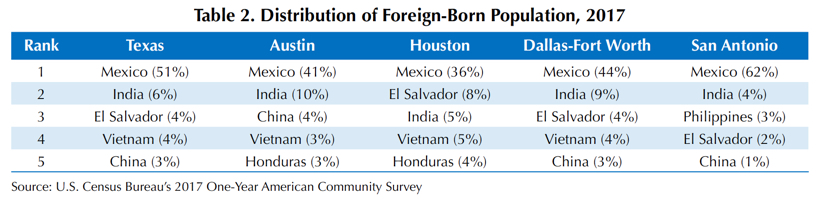
The proportion of foreign-born residents directly correlates with the size of the Metropolitan Statistical Area (MSA). Economic diversity and the magnitude of capital flowing through larger economies better attract individuals regardless of their birthplace. These pull factors outweigh more ostensible determinants of immigration, such as proximity to the border. Although San Antonio’s population is 55 percent Hispanic (or of Latino origin), only 13 percent of the population was born abroad (Table 1). On the other hand, Houston is the most diverse MSA but has the lowest proportion of Mexican immigrants relative to the foreign-born population (FBP) (Table 2).
Who Works Where, and Why?
Excluding Mexican-born residents, the distribution of origin is widely dispersed throughout Texas. India is the only other nation to account for more than 5 percent of the FBP (Table 2). At the aggregate level, the proportion of Asian immigrants jumped from 16 to 22 percent between 2005 and 2017, led by India and Vietnam. The share of African immigrants doubled over the same period, surpassing 5 percent of the FBP. Declines in Mexican immigration pulled down the aggregate share from the Americas, but inflows accelerated from Honduras, Venezuela, and Cuba.
The current family-oriented immigration system incentivizes the formation of cultural clusters, which are evident in the foreign-born distribution at the MSA level. Variations in the FBP have important implications on the local economy because different immigrant groups possess unique skills and economic profiles. For example, Mexican-born residents are three times as likely to work in construction and twice as likely to work in agriculture as the native-born population.
The skill set of an immigrant population determines its industry composition, affecting economic characteristics such as income level. The concentration of Mexicans employed in manual labor (e.g., construction, landscaping, and restaurants) resulted in a median income below $23,000 compared with $30,228 for Texas natives (Table 3). The El Salvadorian population’s employment and income distribution is similar to Mexican immigrants’ with slightly lower educational attainment. The migratory stagnation of these two populations over the past decade has contributed to labor shortages in construction, hindering growth in the state’s housing market.
In contrast, the Indian-born population is booming with growth in the technology sector, particularly in Austin and Dallas-Fort Worth. Nearly a fifth of Indian immigrants work in computer systems design and related services, which are typically high-paying jobs that require post-secondary education. This highly trained immigrant group earns a median wage above $70,000, on par with its educational investment.
The Chinese population also has high educational attainment levels with 67 percent possessing bachelor’s degrees. In the workforce, their greatest impact is in Texas’ universities and colleges. On the other hand, a large proportion of Chinese immigrants work in the restaurant and food-service industry, balancing the median wage around $42,000.
The median wage for Filipino immigrants is slightly above their Chinese counterparts at $43,436. Despite accounting for just 2 percent of Texas’ FBP, they are three times as likely as native-born residents to work in the health care and social services sector, filling a critical void in the workforce. A quarter of Filipinos are employed by hospitals alone.
The economic profile for Vietnamese immigrants matched that of Texas natives in terms of median income and education. This population group, however, is heavily weighted toward the service-providing sector with more than 16 percent of immigrants working in nail salons and 6 percent in restaurants and food services.

Demographic Trends and Challenges
Texas’ rich natural resources, advantageous geographic location, and entrepreneurial attitude have generated a globally competitive economy over the past five decades. But many challenges lie ahead. The aging population and stagnating birth rate portend problems for future generations, weighing on labor-force participation and shrinking the working-age tax base relative to the rest of the population.
Immigration provides a tool to counteract some of the demographic trends. Immigrants typically move to Texas during prime working age, bringing a diverse set of skills to supplement the current labor force. The main industries for both domestic and international immigrants are construction, restaurants/food services, and elementary/secondary schools. The steady flow of workers suggests a shortage in these fundamental sectors of the state’s economy.
Immigrants also fill gaps in the more specialized areas of the workforce. They play an important role in the growing tech industry as well as in colleges, universities, and hospitals. In this case, Texas reaps the benefits of highly skilled workers without having to invest time and money to educate them.
While increasing immigration provides many advantages, it is not uniformly beneficial. Rapid population growth can cause economic friction through higher unemployment, job-market competition, and increased burdens on public services (e.g., school systems, health care, and municipal services). Cultural and political tensions can arise as well. The ongoing immigration debate highlights many of these issues across the political spectrum. It is necessary to consider all of the contributions as well as the costs of immigration to improve the current system and to maintain Texas’ thriving culture and economy.

____________________
Dr. Torres ([email protected]) is a research economist and Miller ([email protected]) a research associate with the Real Estate Center at Texas A&M University.
Did you like this Article?


