
Because of intensive news coverage, many people equate the entire border region with ongoing violence. But El Paso was voted the safest city in America in 2011. Businesses conducting new site selection should not overlook El Paso
Apr 14, 2011
Border Business: El Paso’s Commercial Market
Look beyond the headlines focusing on violence in Juarez. El Paso was recognized as one of the safest cities in the nation, and it is wide open for business.

For decades, multinational companies have weighed the risks and rewards of investing capital and resources outside their home countries. In the case of Juarez, Mexico, the advantages of a low-cost labor force and proximity to American markets have typically outweighed the costs and potential problems faced by firms locating there.
Across the Rio Grande, the City of El Paso has established a successful support system for the 300+ Juarez maquiladoras. About 50,000 El Paso jobs are tied to U.S.-Mexico trade, according to El Paso’s Regional Economic Development Corporation (REDCO).
While this support function serves an important role in the city’s economy, El Paso has often been only an afterthought in a company’s initial decision to locate facilities in Juarez. But the city continues to diversify its economic base.
In the past few years, a new variable — drug violence — has emerged as a greater potential risk for companies considering operations in Mexico. The picture painted by the press is sobering. In Juarez, an average of eight drug-related murders occurred each day during 2010.
In stark contrast to the turbulence in Mexico, El Paso was named the safest city in America with a population greater than 500,000 in 2010. Only five murders were recorded, the lowest annual rate in 46 years.
Prospective companies unfamiliar with the border region no doubt are right to ask questions before locating there.
How have the key commercial real estate sectors in El Paso performed under such extraordinary circumstances? And what is their outlook?
What Drives El Paso?
Core economic drivers for El Paso traditionally have been the level of U.S. and Mexican economic activity, the peso-dollar exchange rate, Juarez maquiladora activity and federal government spending, primarily at Fort Bliss.
Industrial activity in Juarez is still important to the El Paso economy. Dallas Federal Reserve studies reveal that a 10 percent increase in output by Juarez maquilas produces a 3 percent increase in nonfarm employment in El Paso.
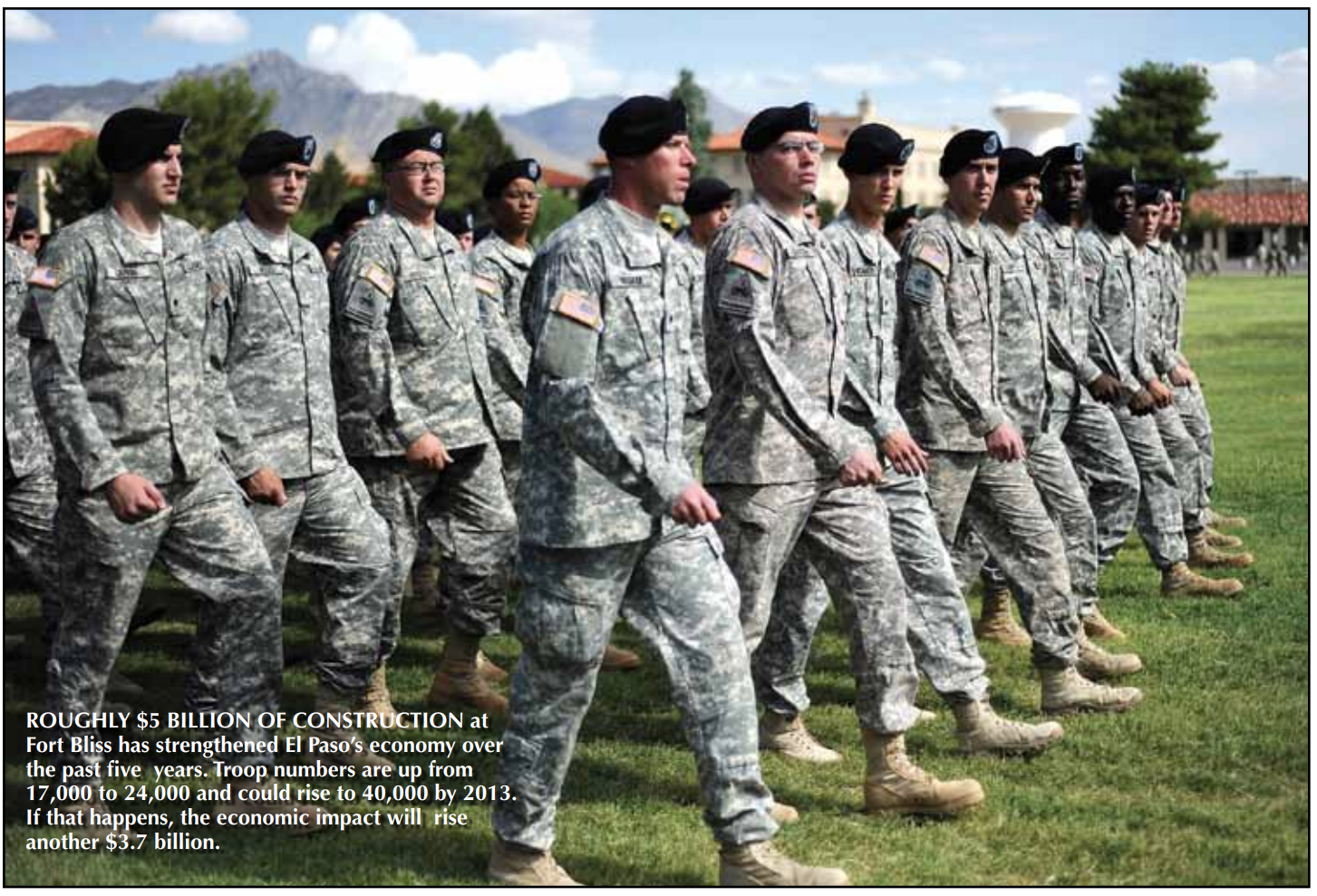
Fort Bliss is the fastest growing Army installation in the country and a huge influence on the city’s economy. About $5 billion in military-related construction has taken place on base during the last five years, yielding a massive increase in new infrastructure.
Annual expenditures at Fort Bliss will drop to about $500 million through 2012. But as infrastructure spending winds down, troop arrivals continue to provide El Paso with a cushion against the U.S. recession. Economic activity is shifting toward the retail and household sectors as base construction slows.
Troop strength at Fort Bliss has increased from 17,000 in 2005 to about 24,000. The number will top out at about 40,000 by 2013, producing an additional $3.7 billion in local economic impact annually. Civilian employment supporting the new troops will increase by about 3,600.
“About 42 defense-related contractors are considering locating facilities in El Paso as the military completes its construction,” says Bob Cook, president of REDCO. Cook is recruiting life science, military defense-homeland security, automobile parts and assembly, and clean technology companies for the region.
Fort Bliss also has been named the Army’s Center for Renewable Energy. The Army has announced that it is dedicated to producing enough energy from wind, sun and geothermal sources to power Fort Bliss with renewables only.

Interestingly, all three of the country’s electrical grids converge about 30 miles east of El Paso along the New Mexico border (see map). As a result, any excess renewable-source electricity could be transported anywhere in the continental United States.
Tight Apartment Market
Fort Bliss troop increases are clearly impacting El Paso’s apartment market. A 2009 study by the Army reported that at least 17,000 soldiers will be in need of off-base housing by 2012. The City of El Paso estimates this will require 8,000 new apartment units.
Only 900 new units were completed in 2010, with another 1,400 units online for 2011 according to Apartment Realty Advisors (ARA). Total apartment stock is about 29,000 units.
Occupancy is climbing steadily, pushing above 97 percent based on data from Apartment MarketData Research Services. Average multifamily rent is about 79 cents per square foot per month (see figure).

Lenders are cautious about financing any new multifamily development. One fear is the possibility of large numbers of Fort Bliss troops being redeployed. Another is the relatively low base housing allowance (BHA) most soldiers receive, about $900 per month. Even with the recent increases, the BHA has kept market rents low compared with the rising cost of new construction.
The BHA is based on local surveys of the rental market. However, older rental properties are often used in the calculations according to Winston Black, broker for Hendricks and Partners.
“The military is trying to change the criteria for calculating the housing allowance to get it increased,” says Black.
The Army considers an adequate housing allowance a vital perk that helps in its mission to retain as many volunteer soldiers as possible.
A shortage of suitable land for apartment construction is another hurdle. El Paso cannot expand like other cities because it is bounded by Mexico, New Mexico and Fort Bliss. Furthermore, three public entities own most of the region’s developable raw land.
HUD has become the lender of choice for new apartment development during the current economic downturn. Their FHA 221(d)(4) loan program begins as a construction loan, automatically converting to permanent financing after construction completion. Recent interest rates have been in the 4 percent range.
Five recent apartment developments were financed through the program. However, HUD has stopped new apartment lending in El Paso, citing overbuilding concerns. Developers are left with conventional financing options offering less leverage because of lower loan-to-value ratios.
Conventional financing also necessitates permanent take-out financing. The result is a much less favorable lending environment for new apartment construction. This should result in a continuation of historically high occupancy rates.
Retail Market Insight
Two major hurdles impede El Paso officials in their efforts to attract retail tenants, according to Jessica Herrera, research coordinator for the city. The first is El Paso’s location and distance from the Texas market.
“El Paso is closer to San Diego than to Houston,” says Herrera. “And helping retailers understand where we are is key.”
Many also have difficulty understanding the culture and significance of the Mexican shopper. REDCO estimates that Mexican nationals generate $1.4 to $1.6 billion in retail trade annually for the city. Their buying power has created an estimated 3,800 retail jobs in El Paso.
In 2008, the City of El Paso teamed with the University of Texas at El Paso to survey 300 retail establishments about their customer base. Stores were located throughout the city. Tenants ranged from local to national firms.
The survey discovered that Mexican shoppers represented about 30 percent of all customers, with some retailers reporting figures as high as 80 percent.
Bob Ayoub, president of Mimco Inc., a local retail management and investment firm, believes that the influx of soldiers is also contributing heavily to local retail sales.
“Even many of the lower-ranked soldiers have the purchasing power of middle-class consumers because of their government-provided housing and medical benefits,” he says.
Ayoub says sales to military personnel are spread across a number of sectors, including automobiles, consumer electronics and restaurants. Dining traffic has also improved in El Paso, with a number of popular Juarez restaurants choosing to relocate on this side of the border.

“Retailers are still taking their time when deciding whether to locate in El Paso,” says Herrera. “We have seen more success with companies that are already in cities in our region such as Albuquerque or Tucson.”
CoStar reported that the overall retail vacancy rate was 5.4 percent in fourth quarter 2010, down from 6.5 percent the previous quarter. Net absorption was a positive 625,000 square feet in the fourth quarter. Total El Paso retail inventory exceeds 44 million square feet.
Industrial Market Dynamics on Both Sides of Border
According to REDCO, prospective industrial space users are conducting much more due diligence these days before they select a location.
“It’s taking longer to make decisions,” says Cook. “However, future economic activity has been a much bigger factor for companies considering placing facilities in our region than border violence.”
Cook has not been able to find a statistical correlation between border violence and any reduced industrial-manufacturing activity in Juarez. He believes it is not his job to convince companies it is safe to operate in Juarez.
“I just try to give companies the facts about locating operations on the Mexican side and let them make their own decisions,” he says.
Cook asks local FBI agents to speak to companies considering locating facilities in Juarez. This visit is followed by a discussion with a private security consultant familiar with operating in Mexico.
Finally, Cook brings in plant managers of facilities already operating in Juarez to discuss how they are dealing with security issues. REDCO estimates that about 3,400 managers, engineers and other white collar employees live in El Paso and work in Juarez.
Anthony Mash, senior vice president of CB Richard Ellis Brokerage Services in El Paso, has noticed a change in priorities by companies already in Juarez.
“For the first time I can remember, industrial tenants operating in Juarez have ranked security as their number one concern over location and rental rate,” he says.
“The companies remaining in Juarez have generally been there for ten to 40 years already,” he says. According to Mash, about 90 percent of his company’s leasing activity in Juarez has been renewals or expansions by existing tenants.
Juarez rents have declined by 25 percent since the last peak. CB Richard Ellis reported that the industrial vacancy rate was about 15 percent in fourth quarter 2010. The average rent for manufacturing space in Juarez was $3.90 per square foot per year.
“Rents are as low as I’ve seen them in eight years,” says Mash. “Juarez witnessed a flood of new industrial construction before the recession began, and that new space still has to be worked through.”
Even with the negative press surrounding Juarez, Mash remains optimistic.
“I think the market has bottomed. We should see increased growth in the Juarez industrial sector in 2011.”
Companies looking at Juarez come from a wide variety of manufacturing sectors, including auto parts, electronics, appliances, consumer products and medical devices. As of August 2010, the breakdown of maquila employment showed that 37 percent of jobs were in automotive and aerospace, 28 percent in electronics and 9 percent in medical devices.
Leasing activity on the El Paso side has been slow as well.
“All movement in the El Paso market is expansion or relocation of existing businesses, not new businesses coming in,” according to Justin Ruby, commercial broker and vice president of the Verde Group.
CoStar reported a warehouse vacancy rate of 14.9 percent for the El Paso market at the end of fourth quarter 2010. The average annual quoted rental rate was $3.63 per square foot, down 23 percent from the peak of $4.69 in first quarter 2010. Net absorption was positive for the second quarter in a row at 120,175 square feet. CoStar shows a total warehouse inventory of 54 million square feet for El Paso.
Seeing the Big Picture
Parts of Juarez are hazardous, but companies continue to operate in even more dangerous places around the world. A 2009 report by the Brown-Wilson Group ranked the 25 riskiest outsourcing hubs in the world. The top five were Bogota, Colombia; Bangkok, Thailand; Johannesburg, South Africa; Kuala Lumpur, Malaysia; and Kingston, Jamaica. Juarez came in 13th overall.
The border region cannot be painted with one brush. Companies that carefully investigate the pros and cons of locating in El Paso may be surprised at the opportunities afforded.
Upscale Living in Downtown El Paso
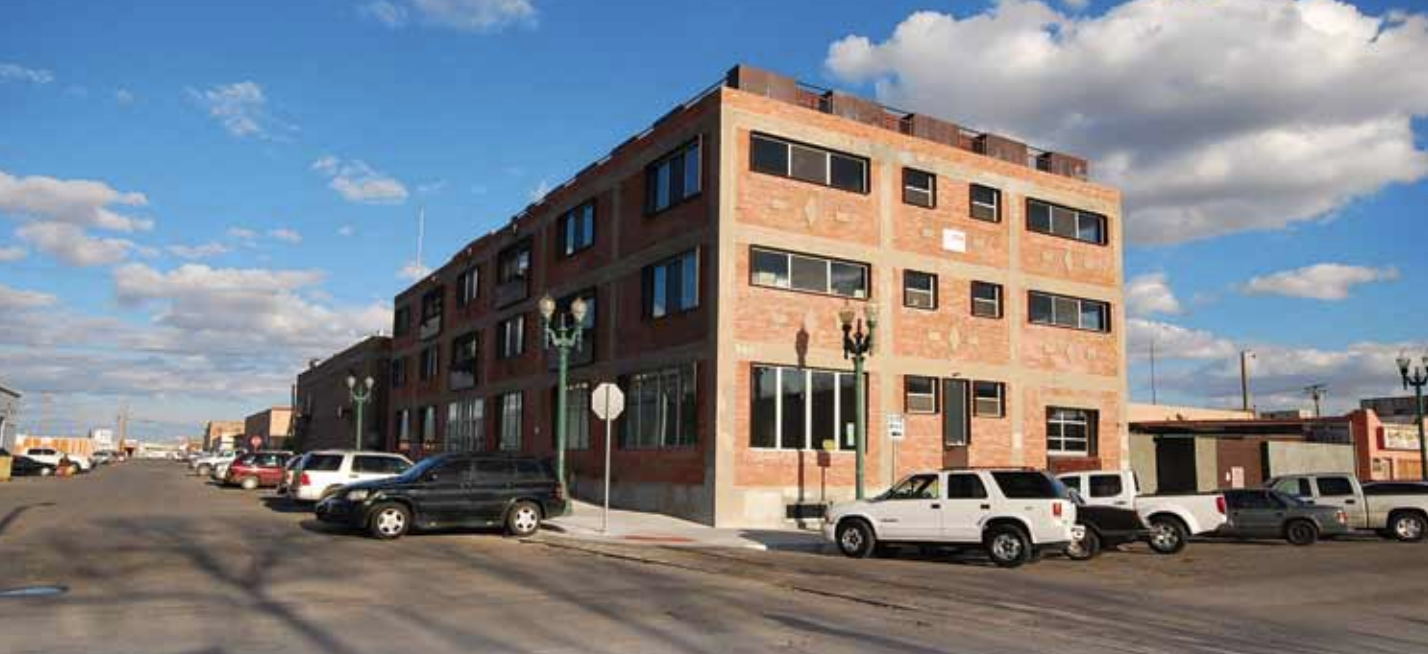
Despite all the recent roadblocks to new construction, developer T.J. Karam managed to transform a 1925 vintage vacant warehouse into downtown El Paso’s first modern, upscale mixed-use condo development.
The nine-unit 1st Avenue Lofts project was completed in February 2010. Along with the loft-style condos, Karam added 4,300 square feet of retail space on the ground floor.
“We are looking for retail tenants that will complement the neighborhood and its residents,” says Karam.
Karam’s decision to develop this unique product in El Paso stemmed from research of similar developments in a number of states, including New York.
“I just thought El Pasoans were missing out on the opportunity to have high quality urban living,” says Karam.
The city paid for the phase I environmental and asbestos survey through the federal Brownfields program to help get the project off the ground. The city’s Tax Increment Reinvestment Zone Board assisted with reimbursable grants for public improvements and the façade. The City Streets Department redid sidewalks and added street lamps.
“I’m the premier downtown condo developer in El Paso, Texas,” says Karam. “I’m also the only one,” he adds jokingly.
Prices for the condos run around $200 per square foot.
Dr. Hunt ([email protected]) is a research economist with the Real Estate Center at Texas A&M University.
Did you like this Article?

You might also like

5 minute read
Mar 04 2020
El Paso
Military and Manufacturing's Influence on Housing
El Paso is closer to San Diego, Calif., than it is to Houston, but don’t be fooled by its remoteness. The city has a rich, vibrant economy fueled by Fort Bliss, manufacturing, and commerce with neighboring Ciudad Juarez.


