
Housing | Winter 2026
From interest rates to inventory, see what’s driving Texas residential real estate.

As the epicenter of America’s pandemic-era housing boom, Texas and cities like Austin, Dallas, Houston, and San Antonio saw home prices soar to record highs, fueled not just by low interest rates, but also migration. Between 2020 and 2024, Texas added 2.01 million residents, of which 76 percent were net migration, both domestic and international.
Where do home prices stand today in these “boomtowns” after a period of rising inflation, climbing interest rates, and declining affordability?
Boomtown Prices Then
Statewide, Texas home prices climbed to $360,000 by summer 2022, reaching the peak of the pandemic housing boom—34 percent higher than $269,000 in 2020.
The state’s top boomtowns each had above average gains of over 40 percent from 2020 to 2022 (Figure 1). Austin (first place) had a nearly 60 percent jump. Already a thriving tech and innovation hub, the city’s appeal was further cemented by the pandemic, which accelerated major corporate relocations and expansions.
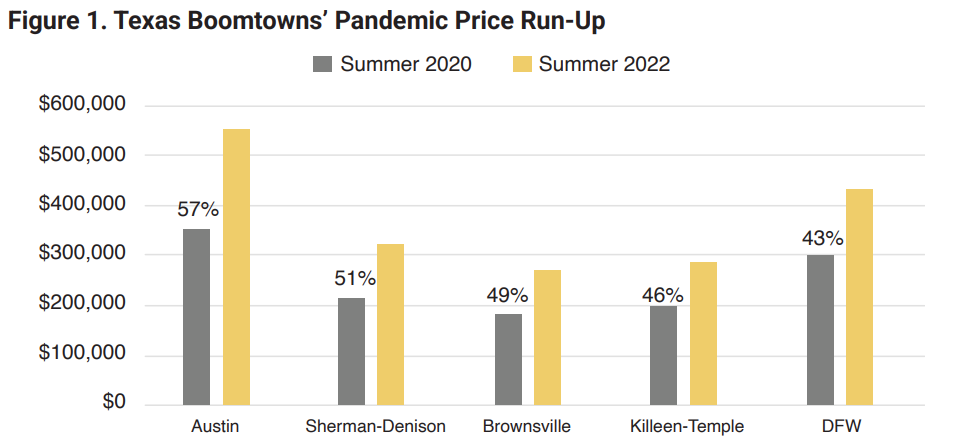
Source: Texas Real Estate Research Center analysis of Data Relevance Project, Texas REALTORS® data
Sherman–Denison ranked second, with home prices rising more than 50 percent. The region has benefited from its proximity to Dallas-Fort Worth and attracted new manufacturing plants and industrial investments.
Brownsville ranked third, posting a nearly 50 percent price surge as the lower Rio Grande Valley region added thousands of jobs through SpaceX expansion and major infrastructure investments.
Killeen Temple-Fort Hood followed closely, with 46 percent price growth, driven by strong pandemic-era population growth and growing healthcare, education, and transportation and logistics industries.
At its peak, DFW’s median home prices surged to $430,000, a 43 percent rise in 2020. Between 2020 and 2024, more than 517,000 people (over 35 percent of Texas’ net migration) flowed into the Metroplex, fueling demand and driving prices upward.
Boomtown Prices Now
Momentum broadly stalled when the Federal Reserve initiated aggressive interest rate hikes in March 2022. Meanwhile, migration into Texas moderated, dampening both net population growth and housing demand across the state.
Statewide, median home prices declined 4 percent from their pandemic peak, yet still posted a 28 percent gain since summer 2020, averaging 5.4 percent annual growth.

Source: Texas Real Estate Research Center analysis of Data Relevance Project, Texas REALTORS® data
Austin felt the brunt of the market cooldown. By mid-year 2025, the median home price dropped 22 percent from its pandemic peak to $440,000, representing a staggering $110,000 loss on the average-priced homes. Home prices currently stand at 23 percent above the 2020 levels, averaging 4.6 percent annual growth in the past five years.
DFW saw moderate corrections with median prices down 7 percent from the peak. Backed by a more diverse economy, DFW has sustained the downturn with 33 percent price growth since 2020, averaging 6.5 percent annually. The region’s median home price settled around $400,000 in mid-2025.
Sherman–Denison followed with a modest 2 percent price correction, preserving most of its earlier gains. The region’s median home price ($315,000) remains nearly 50 percent above 2020 levels, translating to an average annual growth rate of 10 percent. Similarly, the post-pandemic mark cooldown had minimal impact on home prices in Killeen–Temple–Fort Hood ($282,000), where values remain near record highs and close to peak levels.
Brownsville defied the broader housing market cooldown, posting modest price gains. As of summer 2025, home prices there reached all-time highs, up 52 percent, compared to 2020 levels. The median price now stands at $275,000.
Affordability remains a pressing challenge, but buyers are gaining leverage due to elevated inventory levels. Homebuilders are recalibrating, and a wave of more affordable construction is giving buyers greater access to new homes at lower price points. While the boom may be over, Texas remains a top destination for businesses and new residents.
Yanling Mayer, Ph.D. ([email protected]) is a research economist with the Texas Real Estate Research Center.


