
Texas residents have the unique opportunity to streamline the probate process by making their wills self-proving. A self-proving will avoids the necessity of having third-party verification.
Jul 20, 2012
Self-Proving Wills
All wills are not alike. Self-proving wills are simpler to probate because they do not require sworn testimony or an affidavit from someone who witnessed the will or knows the deceased’s handwriting.
Historically, Texas recognized three types of wills. The first was an oral will, sometimes called a nuncupative will or deathbed wish. Because of their limited application, oral wills made (signed) after Sept. 1, 2007, are no longer valid in Texas.
The two other types are still valid. A will written entirely in the deceased’s handwriting is known as a holographic will. A will not entirely in the deceased’s handwriting (typically a typewritten will) is known as an attested will.
Before either can be admitted into probate, it must be proven as the deceased’s last will and testament. For holographic wills, the proof comes from the sworn testimony or an affidavit of two people familiar with the deceased’s handwriting. For attested wills, the proof springs from the testimony or an affidavit from at least two of the people who served as witnesses to the will.
This procedure creates problems, especially when a witness predeceases the maker or can no longer be located. There is, however, an alternative that avoids these problems. It is known as a self-proving will. Self-proving wills can be admitted into probate without the need for sworn testimonies or affidavits.
Contrary to what the name implies, self-proving wills are not a separate and distinct type of will. Instead, they are either a holographic or attested will that needs no independent proof before being admitted into probate. The statutory requirements for making a will self-proving are outlined in Section 59 of the Texas Probate Code (TPC) for attested wills and Section 60 for holographic wills. After Sept. 1, 2014, the two sections merge into the newly enacted Texas Estate Code.
Self-proving wills have the obvious advantage of being easier, quicker and less expensive to prove. But, as with other wills, they can still be contested, revoked or amended.
Self-Proving Holographic Wills
Holographic wills need no witnesses to be valid. The law simply requires that the document be entirely in the deceased’s handwriting and signed. No date is required, but one should be included.
A holographic will may be made self-proving either at the time it is signed or any time thereafter before the maker (testator, if a man, or a testatrix, if a woman) dies. To do so, the maker must swear to and sign an affidavit before a notary stating the instrument is the maker’s last will and testament, and that the maker:
- was at least 18 years old when the will was executed (or, if younger than 18, the maker was lawfully married at the time or a member of the U.S. Armed Forces, an auxiliary thereof or the Maritime Service),
- was of sound mind and
- had not revoked the will.
An officer authorized to administer oaths, which includes notaries and military officers among others, must then place his or her seal and signature on the affidavit (Figure 1 shows an example). The affidavit must then be attached to the will.
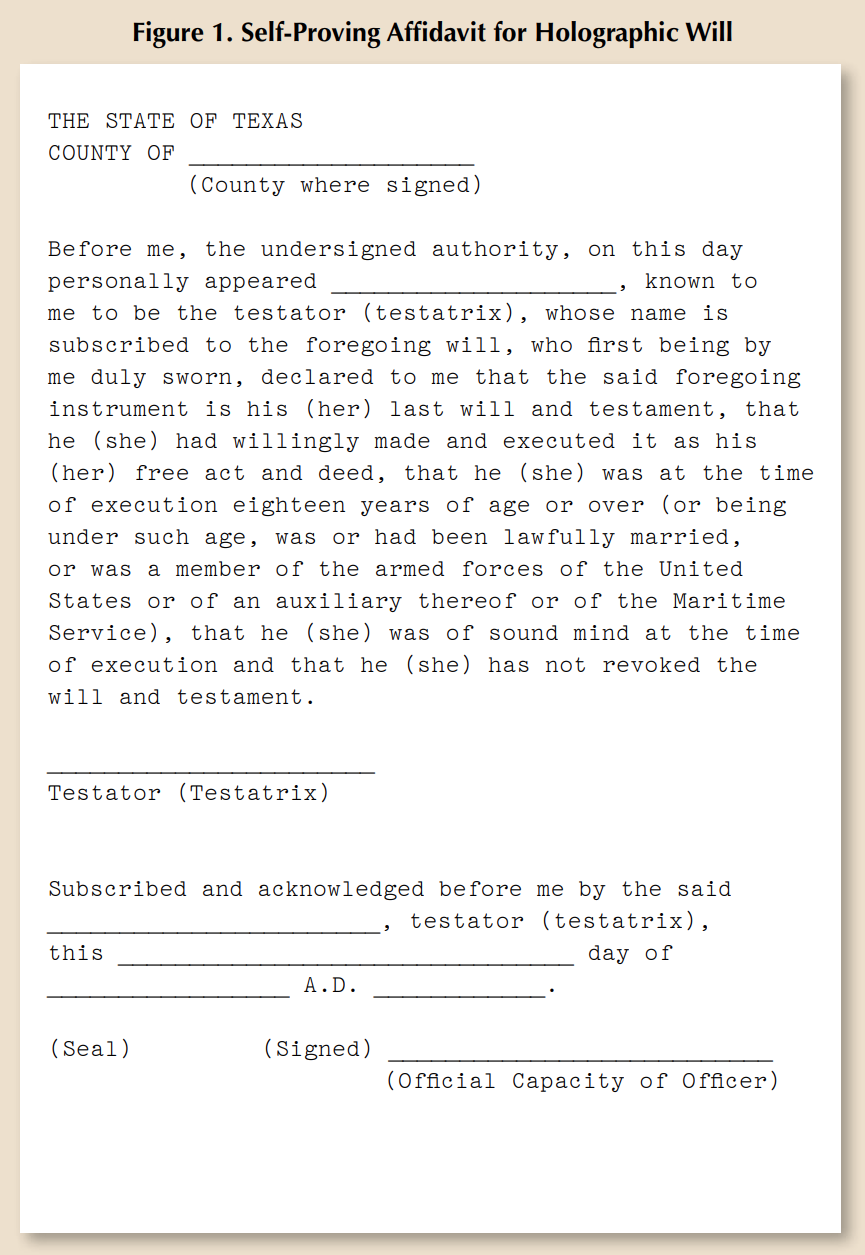
One person can draft (write) and sign a valid holographic will. However, it takes two to make it self proving: the testator (or testatrix) and a notary. The statute does not contain a recommended form for holographic wills, only the required contents of the self-proving affidavit.
Self-Proving Attested Wills
A valid attested will requires the maker’s signature and the signature of two or more credible witnesses. A credible witness is a competent person older than 19 who is not a beneficiary of the will.
The maker need not sign the will in the presence of the witnesses, but he or she must sign prior to the witnesses signing. The witnesses must sign the will in the presence of the maker but not in the presence of each other.
An attested will, as with a holographic will, may be made self-proving at the time it is signed, or anytime thereafter before the maker dies. To do so, the maker and all the witnesses (at least two of them) must sign the promulgated statutory affidavit (Figure 2) after taking an oath before a notary authorized to administer such oaths. The maker and the witnesses must sign the affidavit in each other’s presence and in the presence of the notary. The notary then places his or her seal and signature on the document, and the affidavit is then attached to the will.

The statute makes no distinction in the sex of the maker. In fact, the Probate Code states that the masculine gender includes the feminine and neuter in its definitions. Consequently, the term “testator” as used in the promulgated form refers to either sex.
New Procedure
The 82nd Texas Legislature added a new way to make attested wills self-proving after Sept. 1, 2011 (Figure 3). The new procedure requires the maker and the witnesses to sign only once. The prescribed statutory language of the self-proving affidavit is incorporated into the text at the end of the will, so no separate affidavit needs to be signed and attached.

Under the new procedure, the maker must sign in the presence of the witnesses and notary, the witnesses must sign in each other’s presence and in the presence of the maker and notary, and the notary must sign and affix his or her seal in the presence of the maker and the witnesses.
The new procedure changes the process in another way. Before, the attested will could be made self proving at the time it is signed or anytime thereafter before the maker dies. Now, the attested will must be made self-proving at the time it is signed.
That is not to say that the former option no longer exists. It does. However, the old option does not have the language of the self-proving affidavit incorporated into the text.
The new statute applies only to attested wills. It does not affect the method by which holographic wills are made self-proving.
Wills with Codicils
While the statutes outline the procedures for making wills self-proving, caution should be taken when amending or modifying a will with a codicil. The execution of a codicil, to be effective, must go through the same procedure of signing and being made self-proving as the original will. Otherwise, it may not be admitted to probate, or may not be admitted into probate without additional proof, depending on the circumstances.
Foreign Self-Proving Wills
Prior to Sept. 1, 2011, wills executed in other states or foreign countries could not be recognized as self proving in Texas. The 82nd Texas Legislature amended the statutes to recognize the validity of such wills. Now, a will executed in another state or a foreign country is considered self-proving if done (1) in conformity with Section 59 for attested wills or (2) in accordance with the laws of the state or foreign country of the testator’s domicile at the time of the execution. The statute goes on to state that no matter the laws of the other state or foreign country, the will is considered self-proving if it meets the requirements set forth in Section 59. This article is for information only. For specific legal advice, consult an attorney.
Fambrough ([email protected]) is a member of the State Bar of Texas and a lawyer with the Real Estate Center at Texas A&M University.
Did you like this Article?


