
Texas’ population has grown at an amazing rate over the past 40 years, and the Texas State Demographer projects an even higher growth rate between now and 2050. The state’s four major metros will double or even triple their populations.
Jul 10, 2013
The Amazing Rate
With its population projected to grow by 30 million between now and 2050, Texas is a shoo-in to win any growth rate competition. Think of it as a race from now to the future, during which the state is sure to encounter challenges. Not the least of these will be housing all those folks.

There are more Texans than ever before. There are more young people, more middle-aged people and many more older people. There are more Anglos and considerably more Hispanics. Although the population growth rate during the first decade of the 2000s was slightly less than that of the 1990s, the state still continues to far outpace the national experience and almost all other states.
In the decades to come, several key demographic trends will be particularly significant for their potential effects on Texas’ future. They are:
- the state’s overall rate of growth and urbanization;
- the composition of Texas’ population, especially the growth in non-anglo population groups;
- the principal sources of population growth; and
- shifts in the population’s age distribution.
This is the first of a two-part review of the long-term demographic projections for Texas.
Population Projection Scenarios
Recently, the Texas State Demographer’s Office revised its long-term population projections based on the results of the 2010 Decennial Census. This analysis of the state’s projected population is based on the 2000–10 net migration 1.0 Scenario assumption. This scenario assumes “that the trends in the age, sex and race/ethnicity net migration rates of the post-2000 decade will characterize those occurring in the future of Texas.”
All three population projection scenarios provided by the state demographer include the same set of mortality and fertility assumptions but differ regarding net migration. The other two scenarios, the zero migration 0.0 Scenario and the 0.5 Scenario, generate substantially lower future population projections by assuming that net migration is either zero or half the 2000–10 rate. Consequently, the 1.0 Scenario produces the most aggressive future growth projections.
Projected Population Growth and Urbanization
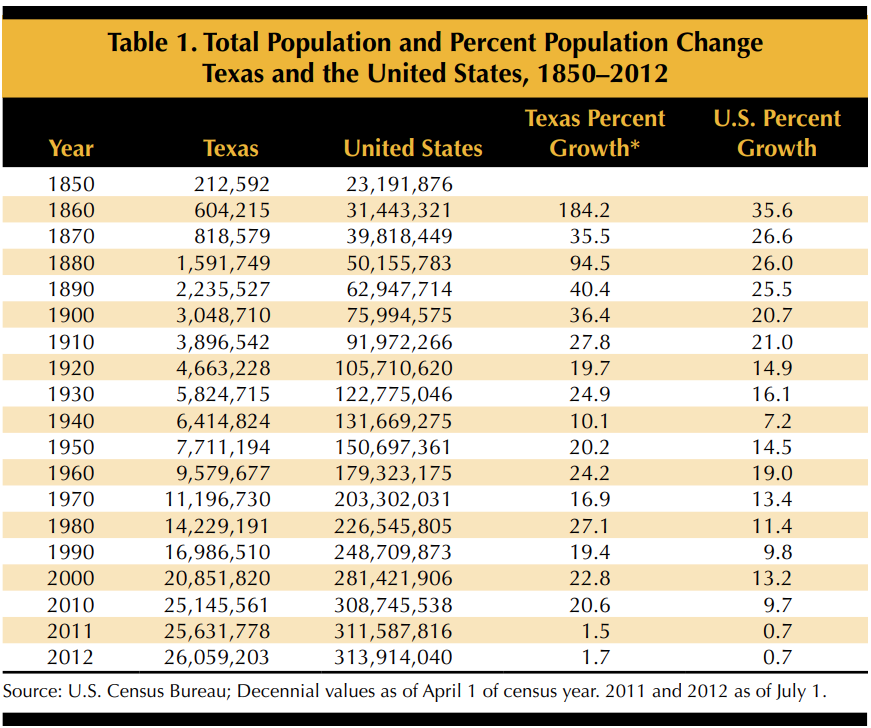
The 2010 Census found that Texas led all states in adding population during the prior decade and was the fifth fastest growing state by rate of increase. Texas added nearly 4.3 million residents between 2000 and 2010, a 20.6 percent growth rate. It gained another 427,425 residents between 2010 and 2012. The state’s total population increased from 20.9 million in 2000 to 25.1 million in 2010 and to an estimated 26 million by 2012.
The nearly 21 percent growth rate from 2000–10 was actually slightly lower than Texas’ historical decennial average. Between 1870 and 2010, Texas averaged 29.4 percent population growth per decade, and nearly 22 percent per decade since 1940 (Table 1).
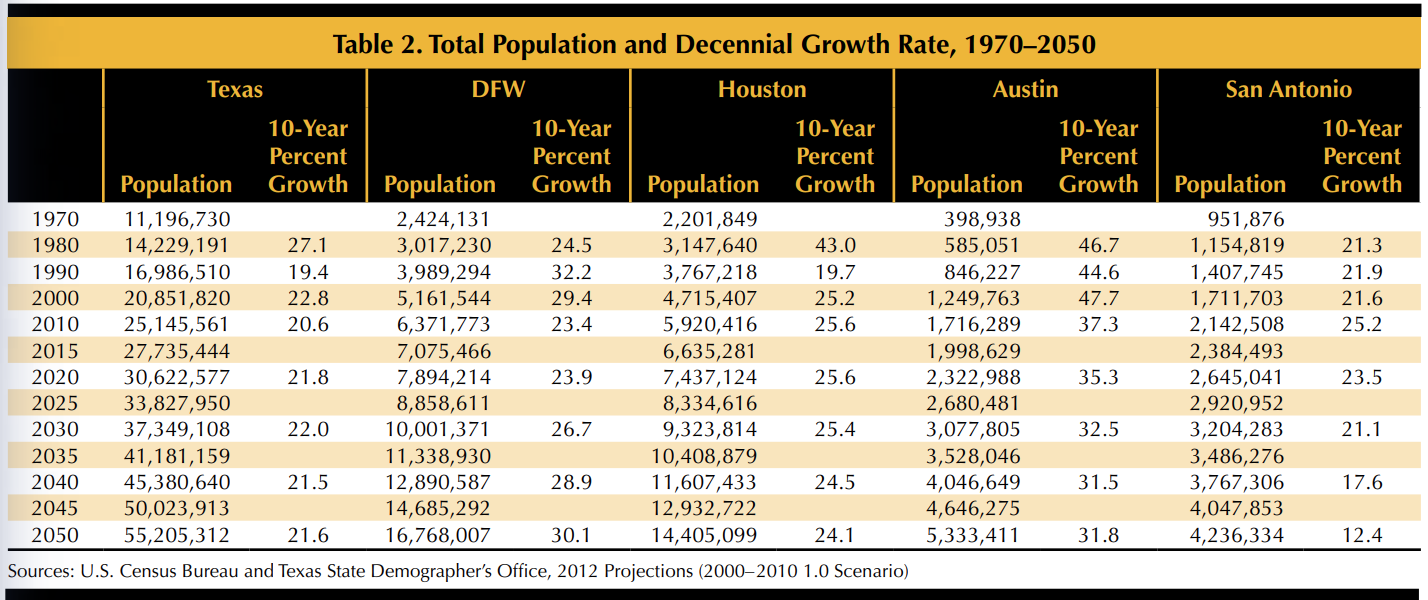
The major metropolitan areas of Dallas-Fort Worth, Houston, Austin and San Antonio expanded at even greater rates, while also capturing an increasing share of the total population. The state demographer’s projections to 2050 indicate that the major urban areas will continue to expand faster than the state as a whole to capture even larger shares of the state’s total population (Table 2).
During the 40-year period 1970–2010, Texas added approximately 14 million residents, an increase of almost 125 percent. In the next 40 years, 2010–50, the state is projected to add around 30 million residents, an increase of nearly 120 percent. This will severely impact the need for more housing. At the long-term average of 2.849 people per household, the growth in population translates to an additional 10.5 million new housing units needed.
The Dallas-Fort Worth consolidated metropolitan statistical area, which includes Dallas, Plano, Irving, Fort-Worth and Arlington (DFW), is projected to expand from a 2010 population of approximately 6.4 million to nearly 16.8 million residents by 2050, an increase of more than 163 percent.
Similarly, the Houston-Sugar Land-Baytown MSA (Houston) will swell to more than 14.4 million residents, a growth rate of more than 143 percent. The Austin-Round Rock-San Marcos MSA (Austin) is expected to more than triple its 2010 population of 1.7 million to more than 5.3 million. The San Antonio-New Braunfels MSA’s (San Antonio) population is estimated to roughly double from 2.1 million in 2010 to 4.2 million by 2050.
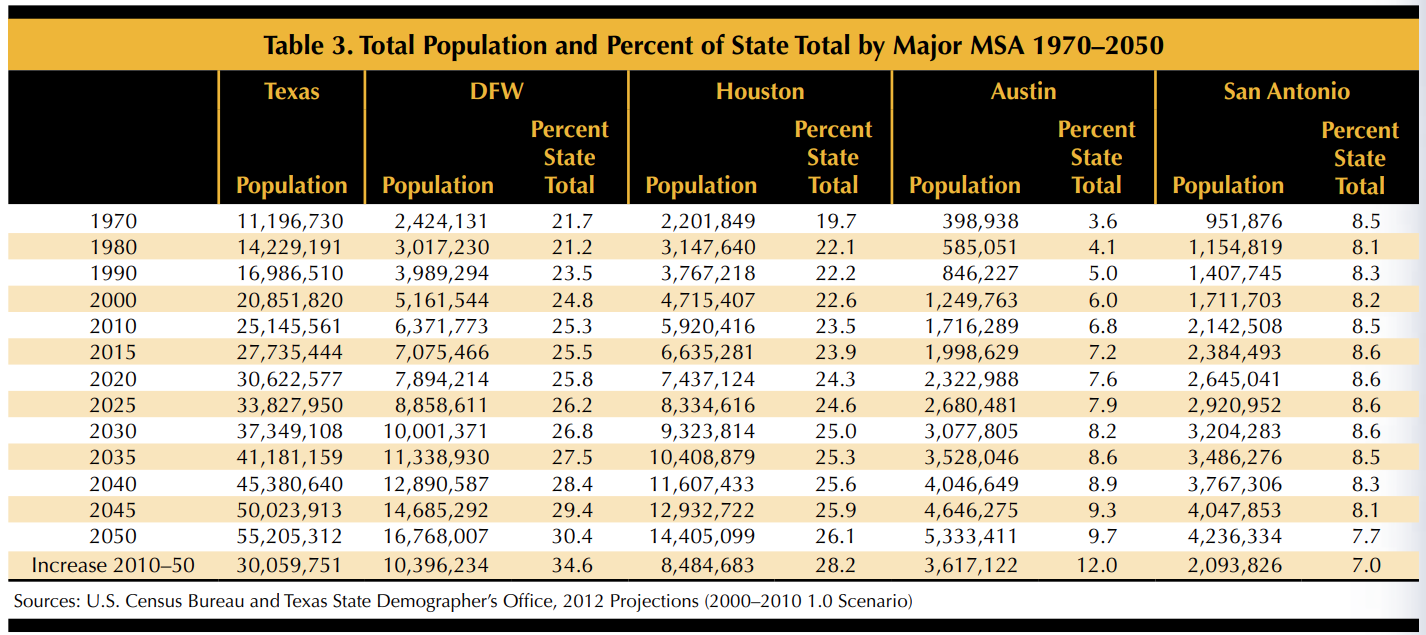
The long-term outlook calls for the ongoing urbanization of Texas. Population will continue to concentrate even more into the state’s principal metropolitan areas. In 2010, almost half (49 percent) of the state’s population resided in either the DFW or Houston MSA. More than 64 percent of the state’s population, almost two-thirds, lived in one of the four major metro areas. By 2050, the percentage of Texas residents located in one of the four major metro areas will approach nearly three-quarters of the total population, with 56.5 percent in either DFW or Houston (Table 3).
Composition of Texas’ Population
Texas’ racial and ethnic population mix represents a microcosm of the national experience, reflecting the rapid growth in Hispanic, Asian and other non-anglo population groups. The Hispanic population in Texas is projected to more than triple from 9.5 million people in 2010 to 30.7 million by 2050. Correspondingly, the Hispanic proportion of total residents will go from 38 percent to 56 percent (Table 4).

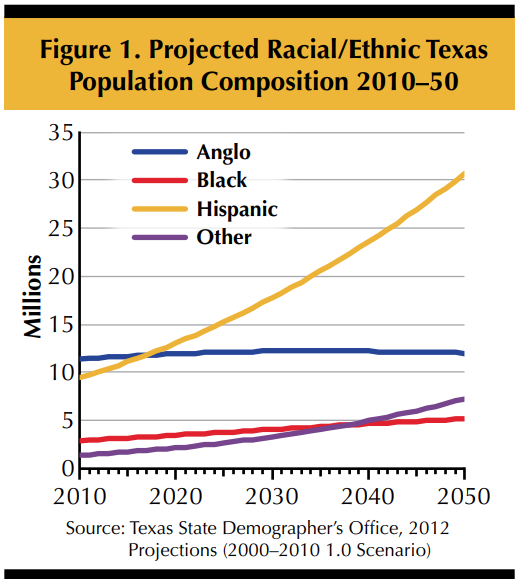
During the same time span, the anglo population is projected to increase by less than one million residents and to decline from 45 percent of the total population to just 22 percent. The “Asian and Other” demographic group is estimated to explode more than fivefold, surging from 1.4 million in 2010 to almost 7.3 million by 2050, an increase from 5.6 percent to 13.2 percent of the total population (Figure 1).
By 2017, Hispanics will outnumber Anglos in Texas. By 2035, Hispanics will exceed 50 percent of the total population and constitute the state’s majority population group. The Asian and Other population will become the state’s third most populous group in 2038, when it is projected to surpass the black population. The anglo proportion of Texas’ population will decline from about 45 percent to less than 22 percent of the total by 2050 (Figure 2).

The composition of the resident population in the four major metro areas is projected to experience similar shifts. The Hispanic percentage of each metro area’s population (except DFW) will exceed half by 2050. DFW’s proportion of anglo and Hispanic populations is expected to virtually reverse between 2010 and 2050. In 2010, Hispanics represented about 27.5 percent of DFW’s total population, and Anglos made up 50.2 percent. By 2050, the anglo percentage will fall to 20.8 percent while the Hispanic proportion will increase to 49.2 percent (Table 5).
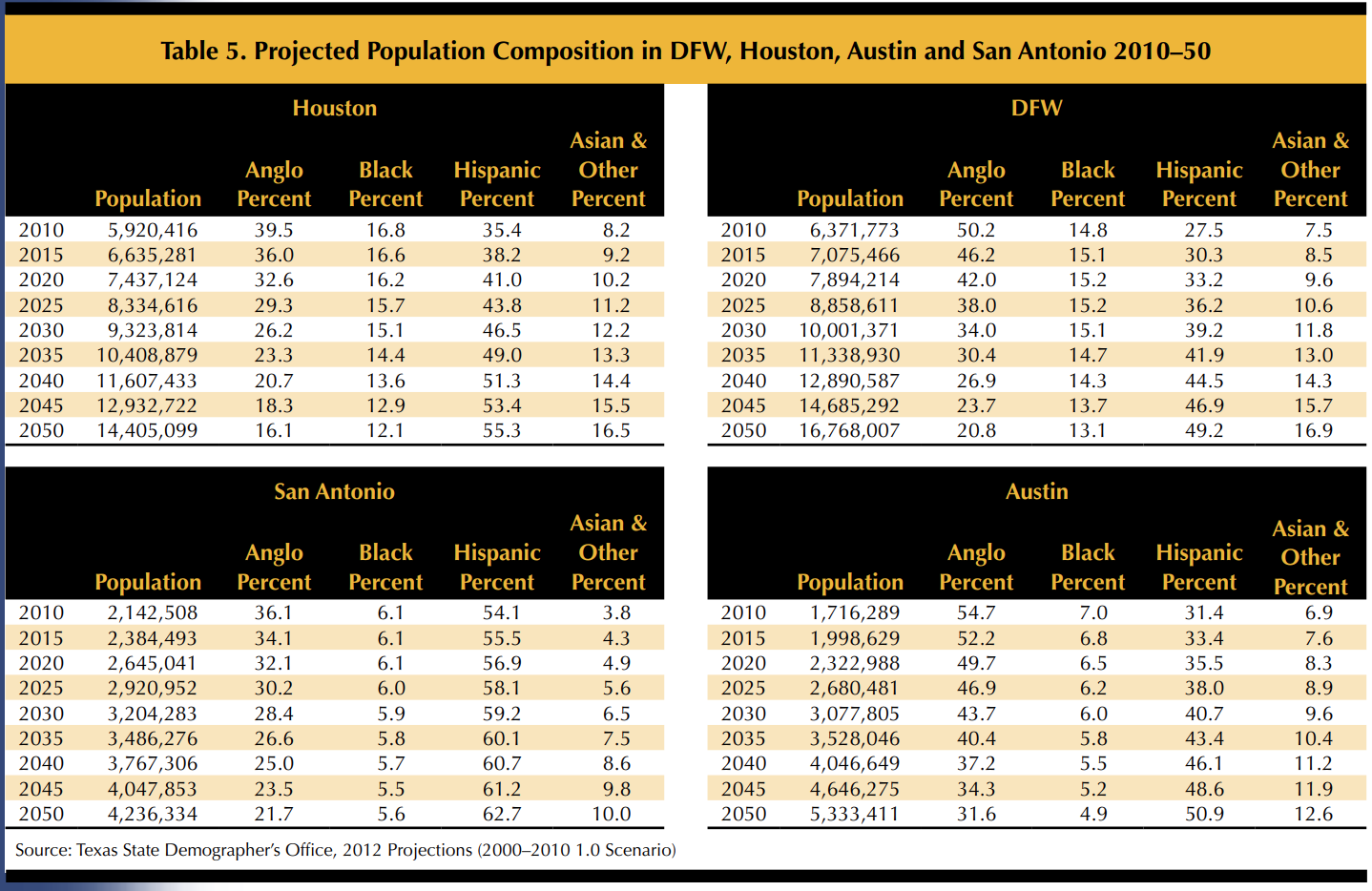
In each of the other major metro areas, Hispanics will be the majority population group (they already are in San Antonio). By 2050, Hispanics will make up 55.3 percent of Houston’s total population, 50.9 percent in Austin and 62.7 percent in San Antonio.
While the total number of black residents in each metro area during the next 40 years is projected to increase, the black percentage of total population is projected to fall. By 2050, blacks are expected to make up 12.1 percent of the total population in Houston, 13.1 percent in DFW, 4.9 percent in Austin and 5.6 percent in San Antonio.
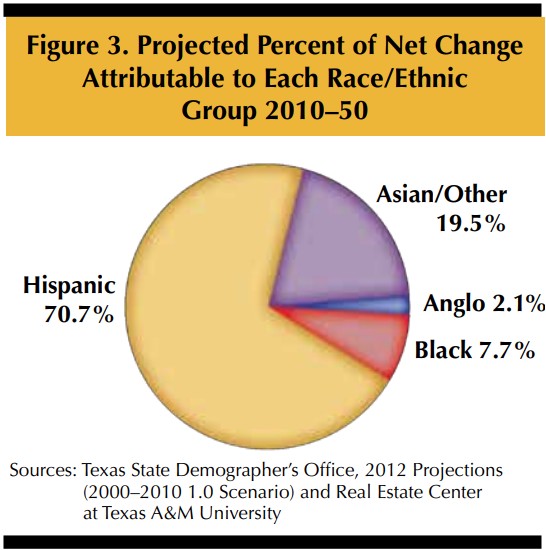
The phenomenal 21.25 million surge in the number of Hispanics will account for nearly 71 percent of the 30.1 million escalation in the state’s total population between 2010 and 2050. Growth of the Asian and Other group will account for another 19.5 percent of the total change in the state’s population. By contrast, the less than one million additional Anglos will account for only 2.1 percent of the state’s total population increase (Figure 3).
During the next 40 years, Texas’ demographics will change even more dramatically than during the past 40. The absolute number of people added to the state’s total population will be more than twice what was added in the past four decades, and the racial/ethnic composition will shift decidedly to a Hispanic majority. Texas will continue to lead in population diversity and remain a true melting pot for the nation and the world.
The second part of this discussion will describe the sources of resident growth and the aging of the state’s population. About half of the total population increase will be natural (births exceeding deaths), and the other half will come from foreign and domestic immigrants moving to Texas. These immigrants will bring their own social and political perceptions, cultural preferences and traits, and unique economic talents.
Dr. Gaines ([email protected]) is a research economist with the Real Estate Center at Texas A&M University.
Did you like this Article?

You might also like

6 minute read
Oct 08 2013
The Amazing Rate, Part 2
Between now and mid-century, Texas’ population will grow at a dizzying rate. New residents will hail from elsewhere in the United States and from around the globe. Distributions of ethnic groups and age categories will shift significantly, resulting in a more diverse and older population.


Demographics & Population
4 minute read
Feb 21 2019
The New Texans
In recent years, Texas has welcomed a steady flow of international immigrants—not just from Mexico but from as far away as India, China, and the Philippines. Read how these new neighbors are changing the face of Texas and brining diverse skills to the workforce.


